Top 5 Hevy Alternatives to Try in 2026

Written By:
Pragati G.
Content Manager @ TheBean.ai

Reviewed By:
Algirdas S.
Founder @ TheBean.ai
Expert Verified


Here's a fun fact about everyone searching "Hevy alternatives" right now: almost no one is trying to save money.
Well, I've spent years watching people quit fitness apps, and there's a pattern to how users quit the Hevy App: they don’t rage quit or delete the Hevy app angry. The app is fast, quite intuitive, and just $2.99/month for Pro.
That's the cheapest paid tier in the entire workout app category. The majority of AI fitness apps cost more and even the free tiers elsewhere are mostly worse than Hevy's free tier.
So this is a strange product category. People are actively looking to leave the cheapest, highest-rated, most-loved app in the space, 14 million athletes, 4.9 stars, and they're willing to pay more to do it.
That only makes sense once you accept what a logger actually is. Hevy remembers what you did, and it doesn't decide what you do next. And somewhere around month six of serious training, remembering stops being enough. You stare at a beautiful volume chart and think: okay, but what do I do about this?
And this is exactly when users (including you 😉) start looking for Hevy alternatives. So what you're really choosing below isn't a replacement but a capability that Hevy doesn't provide.
We tested five apps that answer that question five different ways, verified every price from the source in July 2026, and put our own app through the identical rubric (it’s in the fourth position though). Let's get into it. ✨
The 30-Second Answer
Don't want the full teardown? Here's which Hevy alternative fits which lifter:
If you want an algorithm to build and adapt the whole plan: Fitbod. The most mature workout generator going. It reads your history, equipment, and inferred fatigue, then decides your next session. Priciest here, no free tier, no nutrition. Still the only app on this list that clearly outscores Hevy overall.
If you'd rather run a proven program than trust an algorithm: Boostcamp. Thousands of free coach-written programs (5/3/1, GZCLP, nSuns) with progression and deloads baked in, plus a full tracker, at zero cost. The best free upgrade off Hevy.
If you train at home, travel, or want conditioning in the mix: Freeletics. A real adaptive coach for bodyweight and HIIT that re-plans off your feedback, with the best form videos of the bunch.
If you want training and nutrition in one place: TheBean.ai. The only option here that builds your workouts and your meals from shared data. Newest, least proven, and yes, it’s our platform.
If you just want a faster, cleaner logger: Strong. The quickest logbook on iOS. But read the fine print below, because switching from Hevy to Strong is switching one logger for another, and on the free tier it's usually a downgrade.
Full reviews, scores, and the one honest reason this whole list exists are below. 😉
Why People Look for Hevy Alternatives
Start with what the complaints aren't, because it tells you more than the complaints themselves.
Nobody complains about Hevy's logging, interface, or price. Scroll r/fitness and you'll find something rare in software: people saying nice things about an app they're actively trying to leave.
What actually pushes them out? Five things, in a predictable order.
1. The free-tier wall: Hevy free is genuinely usable, right up until it isn't. You get four routines, three months of history, and seven custom exercises, and if you run a rotating split or want year-over-year charts, you hit all three fast. Pro removes the caps for $2.99 a month, so this is often a $2.99 problem, not a Hevy problem. But it's the moment most people start typing "Hevy alternative" into a search bar.
2. Logging isn't programming. This is the real one. Hevy is a beautiful record of decisions you already made but it doesn't help make them for you. Even with Hevy Trainer generating routines now, you're still choosing the program, and for a lot of lifters the itch is "I don't want to be my own coach anymore."
3. Hevy Trainer reacts to numbers, not to you. Hevy Trainer auto-progresses your weights based on how your last sets went. That's more than a logger does. It's also blind to everything that isn't in the logbook. It doesn't know you slept five hours, that your elbow's cranky, or that you're three days into a work crunch. It bumps the load and hopes.
4. It does nothing for your diet. Hevy has no nutrition support of any kind. For a muscle growth goal, that's half the equation missing, and we'll come back to why food is the half most apps quietly skip.
5. No readiness, no recovery, no wearable. Hevy doesn't touch HRV, sleep, or training-load data. As one head-to-head put it plainly, neither Hevy nor Strong reads your recovery, so tomorrow's suggestion is built entirely on what you lifted today, which is a lagging indicator.
Here's the clean way to think about leaving Hevy. Sort the category into three buckets:
Loggers (Strong, free Hevy): they remember what you did. No opinions, no pretense.
Generators (Fitbod, Hevy Trainer, Boostcamp's engine): they build and progress a plan for you.
Adaptive coaches (Freeletics, TheBean.ai): they take ongoing input and genuinely re-plan.
Hevy is the best logger most people will ever use. So "upgrading" from Hevy means moving out of the logger bucket into one of the other two. Figure out which bucket you actually want, then pick the app. Choose the wrong bucket and you'll churn again in a month.
How We Tested These Hevy Alternatives
Most "we tested these apps" articles were written by someone who opened the App Store, skimmed five screenshots, and reworded the marketing copy.
We didn't score these apps on tracking. Hevy would win a tracking contest, and you wouldn't need us for that. So the rubric is weighted toward the reasons people actually leave: programming and adaptation together carry 45% of the total. Tracking carries 20%. Pricing gets 10%, because as covered above, nobody leaves Hevy over money.
The testing itself was done by Algirdas, TheBean's CEO, who has been in the fitness industry for 15 years. His method for this series hasn't changed: install the app, train with it for about 30 days, log at least a dozen real sessions, and watch what it does after the novelty wears off.
Because let’s get it real: Any AI personal trainer app looks smart during onboarding. Fewer look smart in week three, once the plan has real data to work with and either makes a good call or serves you last Tuesday's workout again.
Factor | What we were really asking | Weight |
Programming & personalization | Does it build the plan, or just store the one you made? | 25% |
Adaptation & AI coaching | Does it change when you change, or freeze on day one? | 20% |
Progress tracking | Can you actually read your volume, PRs, and trends? | 20% |
Ease of use | Fast, frictionless logging in real life | 10% |
Exercise library | Range, quality, and form guidance | 10% |
Pricing/value | What you pay versus what you get | 10% |
Community | Accountability, sharing, social pull | 5% |
Each app earns a score out of 10 per factor, weighted into one overall out of 10. Every number is shown, so you can check our work and tell us where we blew it.
Full disclosure, up front because it matters: TheBean.ai publishes this guide, and TheBean.ai is one of the five apps in it. We ran it through the same rubric as everything else. It finished fourth of five. The number's in there with the rest. Judge it yourself. 😃
Quick Comparison Table: 5 Best Hevy Alternatives
Pricing verified July 2026 from official sources. App-store and regional prices vary, so confirm at checkout.
App | Best For | Free Plan | AI/Programming | Starting Price | App Rating | Score |
Fitbod | Hands-off adaptive generation | ❌ (7-day trial) | High: dynamic generation, recovery-inferred | $15.99/mo or $95.99/yr | 4.8 (280k+) | 7.8 |
Boostcamp | Free coach-designed programs | ✅ (full app) | Med: proven programs + auto-progression, optional AI builder | Free; Pro $4.99/mo | 4.8 (9.9k) | 7.4 |
Freeletics | Home & no-equipment training | ⚠️ Limited | Med: adaptive off self-report | ~$1.54/wk (billed quarterly) | 4.6 (5.3k) | 6.7 |
TheBean.ai | Training + nutrition in one place | ✅ (to start) | Med: dual-agent, conversational | Free to start | NA | 5.9 |
Strong | Simplicity and clean logging | ✅ (3 routines) | None (on purpose) | Free; Premium $4.99/mo | 4.8 (1.9k) | 5.1 |
Hevy (the one we’re comparing against) | Tracking + best free tier | ✅ (capped) | Low-Med: Hevy Trainer, HevyGPT | Free; Pro $2.99/mo | 4.9 | 7.5 (ref) |
The scores tell you who tested well. They don't tell you who's right for you; a home lifter has no use for Fitbod's gym-equipment engine, and a barbell purist will bounce off Freeletics in a week. That's what the individual reviews are for.
What Reddit Recommends Instead of Hevy
Spend an hour in r/fitness, r/weightroom, or r/bodyweightfitness and the same names surface every time someone asks for a Hevy alternative.
If the complaint is "I want a real program, not a blank logger," the thread points at Boostcamp (for proven coach-written plans) or Fitbod (for algorithmic generation).
If it's "I want the simplest possible logbook," people nudge toward Strong.
If it's "I train at home," Freeletics comes up.
The throughline is consistent: most people asking for a Hevy alternative aren't unhappy with Hevy's logging. They want the thing that comes before logging, which is somebody (or something) telling them what to lift.
That migration is what the rest of this guide maps.
5 Best Hevy Alternatives in 2026
1. Fitbod - Best Overall for Hands-Off Programming
Best for: Lifters who want to stop programming entirely and just train, and whose gym situation changes week to week.
About Fitbod
Fitbod has been generating workouts since 2015, and the scale shows: 15M+ downloads, 157 million workouts logged, and a 4.8 rating across 280,000 App Store reviews. In a category where "AI" often means five templates behind a quiz, a decade of shipping the real thing counts.
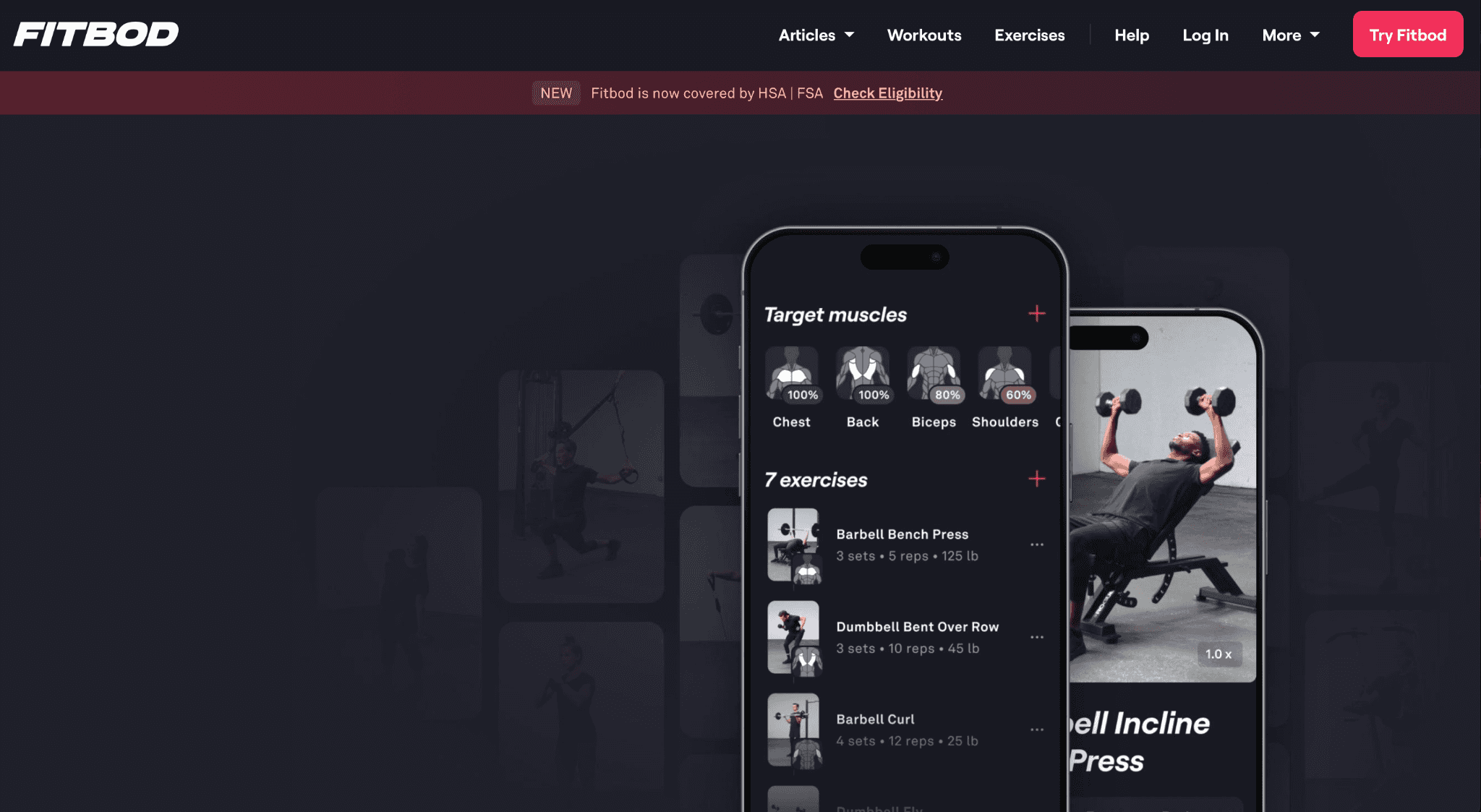
The setup takes three inputs: your goal, your equipment, and how many days you'll actually train. Fitbod builds each session off your logged history, rotates muscle groups using a fatigue model, and raises the load when your numbers say you're ready.
Walk into a hotel gym with two dumbbells, update your equipment list, and it rebuilds the session around what's in the room. Still the best equipment handling in any training app we've tested.
That's the difference from Hevy in one sentence: Hevy remembers your last squat session, whereas Fitbod decides your next one.
And the thing nobody tells you before you subscribe: Fitbod is at its worst on day one. The algorithm needs 10 to 15 logged workouts before the personalization sharpens, so the 7-day trial shows you the interface, not the product. Also, it also does nothing for nutrition.
Pros
Genuinely adaptive session-to-session programming, not a static template
The best equipment-based exercise swaps in the category
A large HD video library so you're never guessing at a movement
Recalibrates cleanly when you miss time or your gym changes
Cons
The most expensive pick here, with no permanent free tier (a 7-day trial that auto-renews)
Zero nutrition support
Recovery is inferred, not read from sleep or HRV
Not conversational, and repetition is a recurring complaint if you don't manage settings
Pricing
$15.99/month or $95.99/year per Fitbod's official membership page, with a 7-day free trial that rolls into a paid plan unless you cancel. You'll spot legacy App Store SKUs floating around at $12.99/mo and $79.99/yr, so check your own checkout screen. It's HSA/FSA eligible with a letter of medical necessity, which quietly drops the real cost for a lot of US users.
AI & Personalization Features
Reads training history, inferred fatigue, and equipment, then generates and progresses each session.
Smart, fast, hands-off.
Not a coach you can argue with.
Who should skip it?
Anyone who wants a free option, cares about nutrition, or wants to talk to their coach instead of just receiving a plan.
Verdict
If your reason for switching is "I'm tired of choosing my own workouts," Fitbod is the most complete answer on this list. You pay for that, in both money and the loss of a real free tier.
Scorecard
Factor | Score |
Programming & personalization | 9 |
Adaptation & AI coaching | 8 |
Progress tracking | 8 |
Ease of use | 8 |
Exercise library | 9 |
Pricing | 5 |
Community | 2 |
Weighted overall | 7.8/10 |
2. Boostcamp - Best Free Coach-Designed Programs
Best for: Lifters who've decided they want a program with a name attached to it, run by someone who coaches for a living, and who'd rather not pay to get it.
Boostcamp solves the specific problem that sends Hevy users to look for alternatives: you've got months of clean logs and no idea what program deserves them. It answers with humans instead of algorithms. Here’s what users are saying on Reddit:
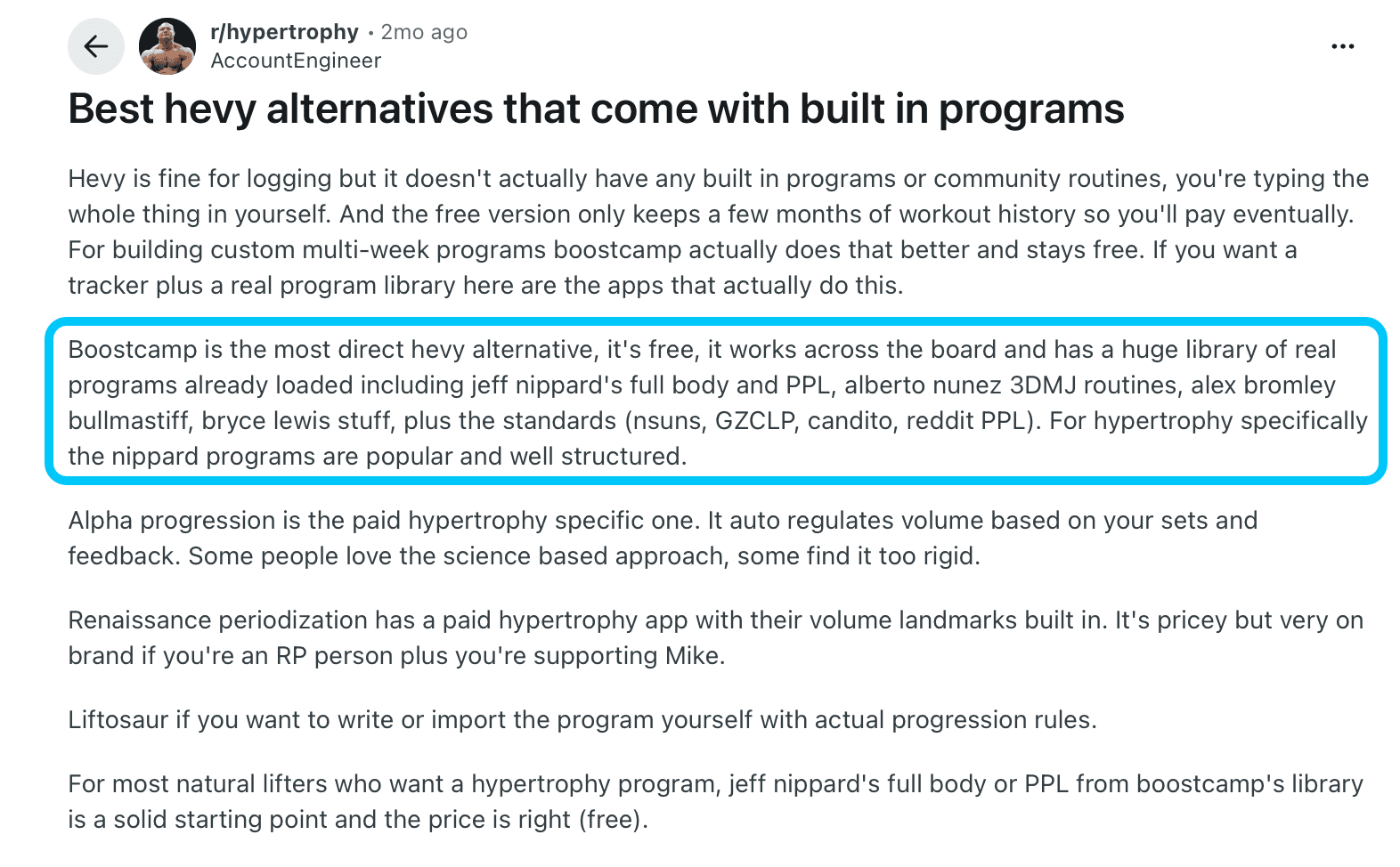
Most apps in this roundup are selling you an algorithm. Boostcamp is selling you the opposite: a library of programs that real coaches already wrote, tested on real athletes, and published with their names on them. Wendler's 5/3/1. Lefever's GZCLP. Helms' hypertrophy work.
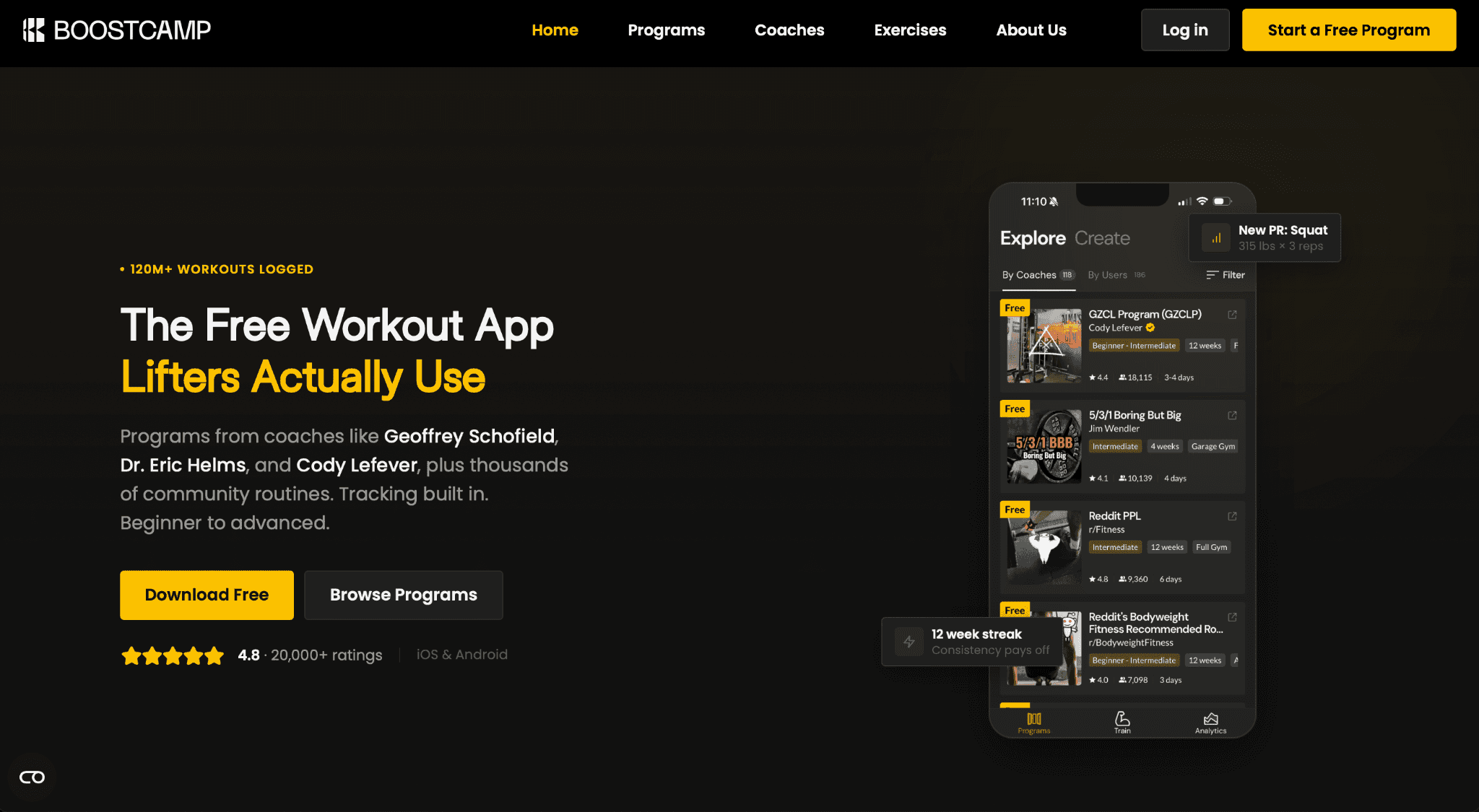
You browse, you pick one, you run it. The software's job is to track and do the load math, not to have opinions.
The reason that matters is boring and correct: a good program is a decision someone already made well. When you run one of the 130+ coach-designed plans in the free tier, the volume, the progression, the deloads, all of it was set by someone who has watched hundreds of lifters run the same block and fail in the same places. An algorithm building a plan "just for you" has none of that history. It's guessing with confidence. Boostcamp isn't guessing at all.
There's a practical bonus most switchers miss: 1.2M+ lifters have logged 300M+ workouts here, and the popular programs have been run by millions of people before you. So when your squat stalls in week five, the answer already exists in a Reddit thread. Try troubleshooting a personalized algorithm's output and you're the only person who's ever seen it.
One honest note from a month of use: the free library is enormous, and most of it is user-uploaded noise. The good stuff is the coach shelf. Filter it and ignore the rest.
Pros
Genuine coach-written programs (the kind usually sold as paid PDFs) at no cost, tracker included
Every plan ships periodized, with progression and deloads already handled
Popular programs come with years of public troubleshooting attached
Logs offline and syncs Apple Watch heart rate, both on the free tier
Cons
A written program can't react to you; hit a rough week and it holds its line anyway
The 11,000-program library is mostly community uploads of uneven quality
Pro's "personalized" periodization is really a short questionnaire, not deep AI
New lifters get a solid plan but little coaching on the why behind it
Pricing
The free tier is the product for most people: full tracker plus every coach program. Pro is $59.99/year ($4.99/month billed annually, 7-day trial) or $14.99 month-to-month, adding 20+ exclusive coach plans, an IPF-DOTS Strength Score, and a per-muscle weekly volume heatmap. That heatmap is the only upgrade I'd think twice about, since weekly volume per muscle is the metric hypertrophy actually responds to.
AI & Personalization Features
Deliberately thin. There's automatic progressive overload on any program and an optional AI builder if you want one, but Boostcamp's whole argument is that you shouldn't need it.
The intelligence is the coaches, and it's been proven on real athletes rather than modeled on your last three sessions.
Who should skip it?
Anyone who wants their plan to adjust mid-block based on how training's going. A periodized program doesn't renegotiate once you start. If you need autoregulation, Fitbod or a real coach is the move.
Verdict
Download this before you pay for anything else. The deal is clear-eyed: you trade real-time adaptation for programming with a track record, and for most lifters that's the smarter half of the trade. It's the rare free app that isn't free because it's worse.
Scorecard
Factor | Score |
Programming & personalization | 8 |
Adaptation & AI coaching | 4 |
Progress tracking | 8 |
Ease of use | 8 |
Exercise library | 8 |
Pricing | 10 |
Community | 7 |
Weighted overall | 7.4/10 |
3. Freeletics - Best for Training Without a Full Gym
Best for: People whose training happens in living rooms, hotel rooms, and hotel-adjacent patches of floor, and who want a coach that works with bodyweight and minimal kit.
About Freeletics
Every other app on this list is a way to keep training the way you already train. Freeletics is the one that quietly asks whether you should. It's built around bodyweight, HIIT, and conditioning, so if you're leaving Hevy because the barbell isn't the goal anymore, that's the whole reason it's here.
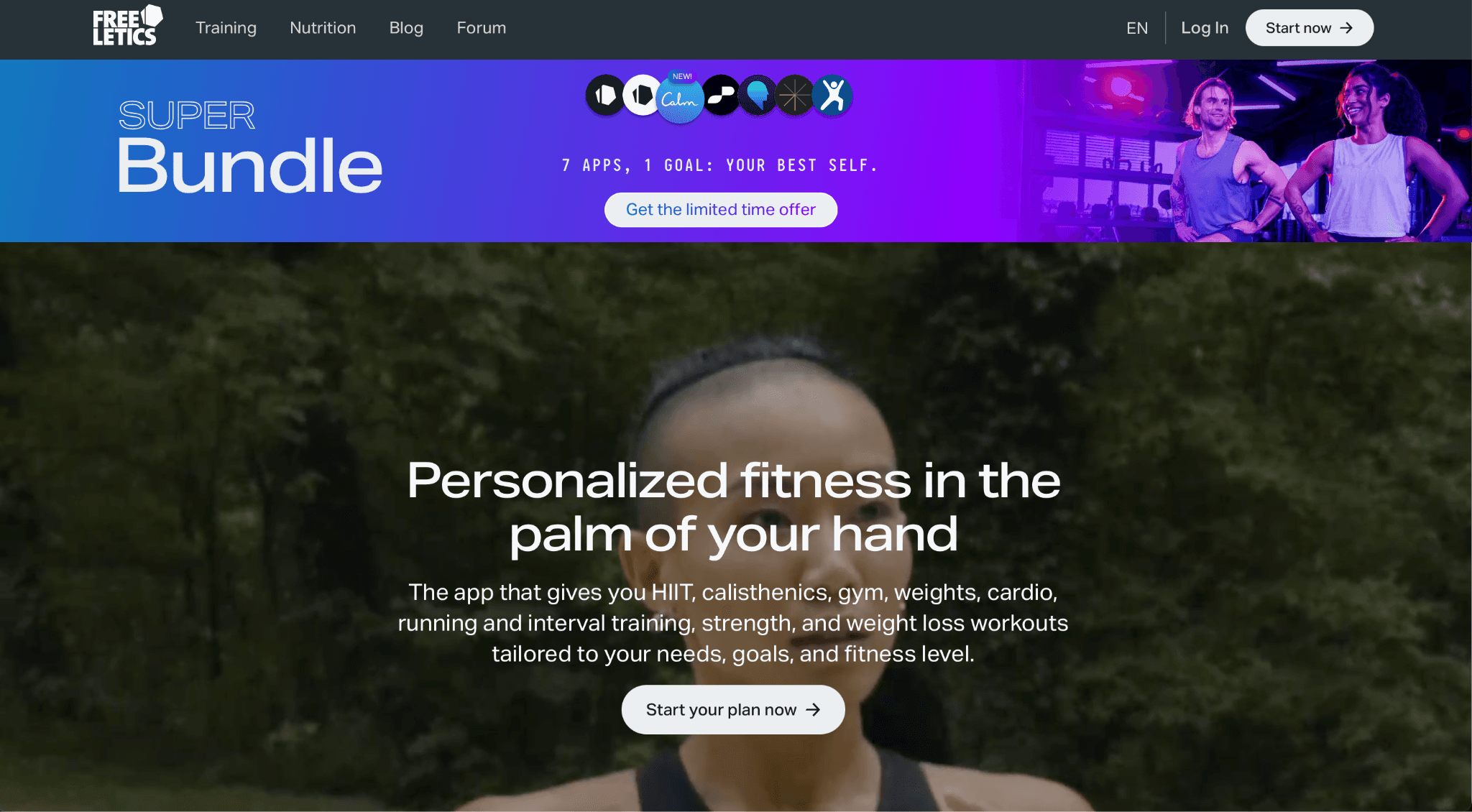
Started in Munich in 2013, it now runs 60 million users across 450M+ sessions, most of that built on one loop: you rate how hard a session felt, and next week bends to that rating. Cruise through, it gets harder. Get buried, it backs off. You hand it your days, your gear, and your minutes, and it programs a real week around the life you have, not the one a template assumes.
It covers HIIT, calisthenics, running, and weights across 180+ exercises, and its 4K three-angle form videos are the best teaching tool anywhere in this roundup.
The honest limit for a Hevy refugee: this is a fitness coach, not a hypertrophy specialist. For a precise, set-by-set barbell block, you'll feel the missing control fast.
Pros
The only app here that coaches conditioning and calisthenics, not just lifting
Genuinely re-plans each week from your effort ratings, no wearable required
4K three-angle form videos worth watching even if you train elsewhere
Programs around zero equipment as easily as a full rack
Cons
Loose as a barbell logbook; precise set-by-set progression isn't its strength
It reads your self-report, so a week of dishonest ratings produces a dishonest plan
Pricing is deliberately murky and the first offer is rarely the real one
Nutrition is real but sits behind a pricier bundle
Pricing: A thin free tier, then the Training Coach around $1.54/week and the Training + Nutrition bundle around $1.92/week, both billed in 3, 6, or 12-month chunks (roughly $40 and $50 a year). Wait for a promo. There's almost always one running, and paying the sticker price here is a rookie move.
AI & Personalization Features
Effort-driven, not data-driven.
It adapts off what you tell it after each session rather than what a watch measures. That's a weakness on paper and a quiet strength in practice, since a rating you actually give beats an HRV number you ignore.
Who should skip it?
Anyone whose entire goal is a heavier squat, bench, and deadlift. Freeletics will get you fit; it won't obsess over your working sets the way a dedicated lifting app does.
Verdict
If leaving Hevy is really about leaving the barbell, or at least sharing time with bodyweight and conditioning, nothing on this list comes as close as Freeletics. Judge it as a fitness coach that travels, not a hypertrophy app, and it's excellent at exactly that job.
Scorecard
Factor | Score |
Programming & personalization | 7 |
Adaptation & AI coaching | 7 |
Progress tracking | 6 |
Ease of use | 8 |
Exercise library | 7 |
Pricing | 5 |
Community | 6 |
Weighted overall | 6.7/10 |
4. TheBean.ai - Best for Training and Nutrition in One Place
Best for: Lifters who log training in one app and track food in another, and are tired of being the integration layer between them.
About TheBean.ai
Time to review our own app, and no, it didn't get a privilege on the rubric. Here's the case for TheBean.ai and the case against, both from us.
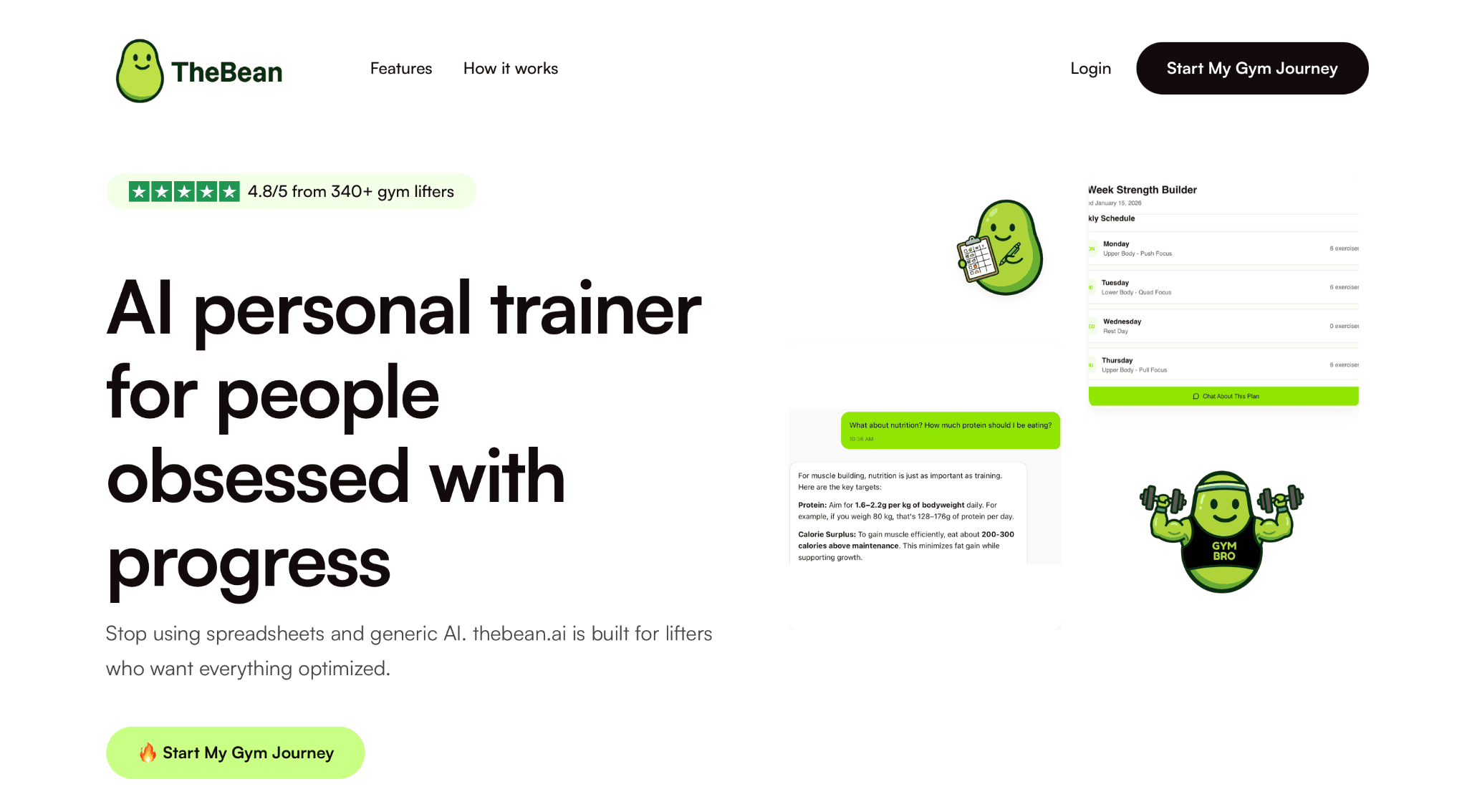
If you use Hevy, you already live half of what TheBean does. You log every session religiously. Then you open a second app to track macros, and the two never speak. Train legs hard on Monday and your calorie target should move; instead you update it by hand, if you remember.
TheBean closes that gap.
Two agents, GymBro Bean for training and Macro Bean for food, read from one shared memory of your goals, injuries, and preferences. Push your training and your calories rise on their own. Change either by typing a sentence.
That link isn't just for attracting more users. The ISSN puts the muscle-building protein target at 1.4 to 2.0 g/kg, and every other app on this list stays silent on food. Solving only the training half is solving half the problem.
Now the thing to note: it's web-first, has no native app, and 340+ early users is a rounding error next to Hevy's millions. Early. Pointed at the right gap, but early.
Pros
Training and nutrition run off one shared memory, the only app here that does this
You steer both by chatting, not by digging through settings menus
Calorie targets move with training load automatically, no manual math
Free to start, and there's genuinely nothing else to bolt on
Cons
Young and small; the multi-year track record simply doesn't exist yet
Web-only for now, which stings if you want to log from your wrist
No wearable or recovery input on the roadmap's near horizon
Thinner exercise and program library than any veteran on this list
Pricing
Free to start on the web. Paid tiers aren't published yet, so treat pricing as a "check when you sign up" until we put real numbers on the site.
AI & Personalization Features
The only conversational, dual-agent setup here.
You talk to a training coach and a nutrition coach that share one brain, so a change on one side updates the other without you repeating yourself.
Deeper, recovery-aware adaptation is a roadmap, not shipped, and we'd rather say that than imply otherwise.
Who should skip it?
Anyone who needs a finished, battle-tested product today, wants a native mobile app, or expects recovery-driven coaching right now.
Verdict
It lands fourth here, and that's the correct spot for a young app against proven ones. What earns its place is the thing none of the others attempt: treating your lifting and your eating as one problem instead of two apps. If that's the exact friction driving you off Hevy, try it. If you want a decade of receipts, the apps above have them.
Scorecard
Factor | Score |
Programming & personalization | 7 |
Adaptation & AI coaching | 6 |
Progress tracking | 5 |
Ease of use | 6 |
Exercise library | 5 |
Pricing | 7 |
Community | 3 |
Weighted overall | 5.9/10 |
5. Strong - Best for Minimalists Who Bring Their Own Program
Best for: Lifters who already have a program and want the single fastest way to record it, plus the best Apple Watch experience in fitness.
About Strong
Every other app on this list gives you something Hevy doesn't. Strong gives you less than Hevy, and that's the whole reason to pick it.

Strong launched in 2014 and has spent a decade taking features out instead of putting them in. No social feed. No AI. No nutrition. You open it, log a set in two taps, and get back to your rest timer. Over 5 million lifters use it, including plenty who tried the busier apps and came back to this one.
So why leave Hevy for an app that does less? Well, there are two reasons.
The first is speed: Strong is the fastest logger there is, and if you find Hevy's social feed and Trainer prompts more distracting than useful, Strong strips all of that out.
The second is the Apple Watch app, which is the best in the category. You can run an entire session from your wrist without touching your phone, which anyone who's fumbled for a phone mid-set with chalky hands will appreciate.
The catch is what you'd expect from an app this stripped-down. Strong won't tell you what to lift or when to add weight, and its free tier caps out at three routines, so regular users end up paying for Premium. If you came here wanting the app to think for you, this is the wrong door.
Pros
Two-tap logging that's genuinely faster than anything else, Hevy included
The best Apple Watch app in fitness, fully usable phone-free
More depth than the minimalism implies: RPE, charts, body stats, a muscle heat map
Refreshingly unwilling to pretend it's something it isn't
Cons
Zero programming or adaptation, so a Hevy user gains nothing on that front
Free tier is thin at three routines; real use means paying
Strongest on iOS; Android has trailed on features for years
No nutrition, and the design is beginning to feel dated
Pricing
Free forever for basic logging with the three-routine cap. Premium runs $4.99/month or $29.99/year; a lifetime tier has surfaced historically near $99.99, though it comes and goes, so check in-app before counting on it.
AI & personalization features
None, stated proudly. You bring the program; Strong's only job is to record and chart it, and it does that better than apps ten times as complicated.
Who should skip it?
Anyone switching apps to gain intelligence. Strong subtracts by design, so if you left Hevy wanting a coach, this is a hard left turn in the wrong direction.
Verdict
It scores low here because the rubric rewards programming and Strong refuses to program. Read past the number: for a self-coached lifter who wants speed and a flawless Watch app, it's a genuinely great pick, arguably better than Hevy at that one narrow job. Just know you're buying minimalism, not muscle-building help.
Scorecard
Factor | Score |
Programming & personalization | 4 |
Adaptation & AI coaching | 1 |
Progress tracking | 8 |
Ease of use | 9 |
Exercise library | 7 |
Pricing | 6 |
Community | 2 |
Weighted overall | 5.1/10 |
Hevy vs the Alternatives: Feature Comparison
Feature | Hevy | Fitbod | Boostcamp | Freeletics | TheBean.ai | Strong |
Workout generation | ⚠️ Hevy Trainer | ✅ | ✅ Programs + AI builder | ✅ | ✅ | ❌ |
Adaptive re-planning | ⚠️ Auto-progression | ✅ Recovery-inferred | ⚠️ Auto-progression | ✅ Self-report | ⚠️ Basic, roadmap | ❌ |
Progress tracking | ✅ Volume/muscle | ✅ | ✅ | ✅ Basic | ✅ Basic | ✅ Deep |
Nutrition | ❌ | ❌ | ❌ | ✅ Add-on | ✅ | ❌ |
Recovery / wearables | ❌ | ⚠️ Inferred | ⚠️ Watch HR | ❌ | ❌ Planned | ⚠️ Watch |
Exercise library | Large + video | Large + HD video | 11,000+ programs | 700+ + 4K video | Smaller | ~300+ |
Free plan | ✅ Capped | ❌ Trial | ✅ Full app | ⚠️ Limited | ✅ To start | ✅ 3 routines |
Platforms | iOS, Android, Watch, web | iOS, Android | iOS, Android, Watch, web | iOS, Android | Web only | iOS, Android, Watch |
Starting Price | Free / $2.99 | $15.99/mo | Free / $4.99 | ~$1.54/wk | Free to start | Free / $4.99 |
Workout Philosophy Comparison
The fastest way to pick is to match the app's core belief to yours.
App | Core Philosophy |
Hevy (the one we’re comparing against) | Track first, program second |
Fitbod | Generate and adapt on demand |
Boostcamp | Run a proven, coach-written program |
Freeletics | Conditioning anywhere, minimal gear |
TheBean.ai | Training and nutrition in one system |
Strong | Simplicity above all |
What Makes a Great Hevy Alternative?
The best alternative closes the gap between logging your training and directing it. Five things separate the ones that do from the ones selling an AI badge, each backed by research worth knowing.
Programming built around you: Identical programs produce strength gains from −8% to +60% across people. The ACSM's 2026 guidelines now formally reject one-size-fits-all prescriptions. A logger can't personalize; a good alternative has to.
Volume it can move, not just show: Weekly sets per muscle is the main hypertrophy lever, with the ACSM target around 10 sets per muscle per week and each added set still adding growth. Hevy graphs that number. The upgrade is an app that also adjusts it.
Automatic progressive overload: Growth needs steadily rising demand on the muscle. A logger leaves that to your memory. A good alternative applies it for you.
Nutrition, because it's half the result: Muscle needs 1.4 to 2.0 g/kg of protein per the ISSN, and nearly every app here ignores food. Touching diet is real differentiation.
Recovery, framed honestly: HRV-guided training helps at the margins, not the core. It's a nice input, not a reason to pay a premium.
Something you'll still open in week five. In a 2026 study of 522,994 users, only 18.1% of beginners were still training at six months, median dropout at week 14. Early consistency decided the rest. The best app is the one that keeps you showing up.
One reframe to carry into the reviews. The AI-fitness market is climbing from $10.68 billion toward $57.80 billion by 2035, and most of it is chasing the same two letters on the box.
Ignore the badge and ask one question: what does this app do between my workouts? Every pick below has a real answer, and the right one depends on which answer you need.
Which Hevy Alternative Should You Choose?
If you want | Choose |
Hands-off algorithmic programming | Fitbod |
Free, proven, coach-written programs | Boostcamp |
A coach for home / no-equipment training | Freeletics |
Training and nutrition in one place | TheBean.ai |
A minimalist logbook for self-programmers | Strong |
Our Final Rankings
Fitbod (7.8): the most complete programming engine here, at the highest price
Boostcamp (7.4): the best free pick, and the smartest one if you trust coaches over algorithms
Freeletics (6.7): the pick if you train without a full gym
TheBean.ai (5.9): promising and honest about its early stage
Strong (5.1): a brilliant logbook for self-programmers, scored low here because this rubric rewards programming
One pattern worth noticing in those numbers: the top two finished within half a point of each other while charging $95.99 a year apart. That's the real decision for most people reading this.
If you want the app to make every call, pay for Fitbod.
If you're happy following a proven plan and making the calls yourself, Boostcamp does the job for free.
Freeletics, TheBean.ai, and Strong are specialist picks, home training, nutrition integration, and minimalism respectively, and if one of those specialties is your whole reason for switching, the overall score matters less than the fit.
Whichever way you go, move your data. Every app here imports workout history via CSV, so those months of logged sessions come with you. Your training age transfers. Your logbook should too.
Frequently Asked Questions (FAQ)
1. What is the best Hevy alternative?
Well, the best alternative depends on what you're missing. For hands-off algorithmic programming, Fitbod scored highest in our testing (7.8/10). For free, proven, coach-written programs, Boostcamp is the best pick. If you want training and nutrition together, TheBean.ai is the only option here that does both from shared data.
2. Is there a free Hevy alternative that's actually good?
Simply, it’s Boostcamp. Its free tier is the real app, not a trial: 11,000+ programs, full tracking, RPE logging, and analytics with no time limit. It's the rare "free" app that doesn't lock the good stuff behind a paywall.
3. Is Strong better than Hevy?
Only on speed and Apple Watch. As a logger Strong is faster and cleaner, but its free tier is tighter (three routines vs Hevy's four) and Premium costs more ($4.99 vs $2.99/month). If you left Hevy wanting programming, Strong is the wrong direction, since it has no AI at all.
4. Is Fitbod better than Hevy?
For programming, yes Fitbod is better than Hevy. Fitbod generates and adapts your entire plan, which Hevy doesn't fully do even with Hevy Trainer. But Fitbod has no free tier and costs $15.99/month, so you're paying roughly five times more for the app to make decisions for you.
5. Why are people leaving Hevy?
Mostly the free-tier caps (four routines, three months of history), the wish for real programming instead of pure logging, no nutrition support, and no recovery or wearable input. Rarely price, since Hevy Pro is the cheapest paid tier in the category.
6. Does Hevy have AI now?
Yes, sort of. Hevy Trainer launched in February 2026 and generates programs while auto-progressing your weights, and HevyGPT drafts routines from a text prompt. Both are Pro-only, and neither reads your recovery or adapts to your week, so it's smart autofill more than coaching.
7. What's the best Hevy alternative for muscle growth?
For programming that targets weekly volume per muscle, the main hypertrophy driver, Fitbod and Boostcamp lead. Fitbod generates and progresses it; Boostcamp hands you proven periodized programs that already do. Both close the gap Hevy leaves open.
8. What's the cheapest Hevy alternative?
Boostcamp's free tier is the cheapest that still gives you real programs, and it's free forever. Among paid apps, Boostcamp Pro and Strong Premium sit at $4.99/month. For most switchers, Boostcamp free covers everything they'd otherwise pay for.
9. Which Hevy alternative is best for home or no-equipment training?
Freeletics. It's built around bodyweight and HIIT, with 4K three-angle form videos and a coach that re-plans week to week off your feedback. For barbell hypertrophy, a dedicated lifting app serves you better.
10. Which app combines workout tracking and nutrition?
Among the apps here, TheBean.ai is the only one that generates both training and nutrition from shared data. Freeletics offers nutrition as a separate add-on. Hevy, Fitbod, Boostcamp, and Strong don't touch food at all.
11. Do I need an app that reads my HRV or wearable data?
It's a nice-to-have, not a requirement. Recovery-guided training reliably improves HRV markers but shows only a small edge on actual performance versus a smart fixed plan. None of the apps on this list are HRV-driven, and most lifters do fine without it.
12. Can a workout app replace a personal trainer?
For programming, progression, and tracking, increasingly yes. For hands-on form correction and real human accountability, not fully. The best setup today is a hybrid: let the app handle the plan and the data, and get a human (or a mirror) to check your technique.
13. Should I just stay on Hevy?
Ask what you're actually missing. If it's only the free-tier routine caps, Hevy Pro fixes that. But no upgrade turns a logger into a coach, if you want full programming, adaptive coaching, or nutrition handled, those are capability gaps, and switching to an app built for them is the right call.
14. Which Hevy alternative is best for beginners?
Boostcamp, for a guided, proven program without paying, or Freeletics if you want a coach that walks you through everything. Both give a new lifter more direction than a blank logger ever could, and early consistency is the single strongest predictor of long-term results.
15. Are AI workout apps actually effective?
When they apply real training principles, yes. Progressive overload drives strength and size, and apps that automate it work. Effectiveness depends far more on whether you keep showing up than on how clever the algorithm is.


