5 Best AI Fitness Apps in 2026: We Tested the Top Apps

Written By:
Pragati G.
Content Manager @ TheBean.ai

Reviewed By:
Algirdas S.
Founder @ TheBean.ai
Expert Verified


The 30-Second Answer
If you don’t have time to read the entire breakdown, here’s a shorter version that can help you select the best AI fitness app as per your needs:
If you want the app to plan your gym sessions for you: Fitbod. It decides your next sets so you don't have to, and it actually re-plans when you're sore or skip a week. However, it’s the priciest of the bunch and does nothing for nutrition, but still the most capable.
If you’re a beginner or looking for an affordable option, go for: Hevy. The free tier covers unlimited logging and progress tracking, which is genuinely enough for most people, and it now includes algorithmic programming too.
If you already write your own programs: Strong. The fastest, cleanest workout logger on iOS. It has no AI and no extras by design, which is exactly why experienced lifters stick with it.
If you train without a gym: Freeletics. The strongest bodyweight and HIIT coaching here, and it genuinely adapts week to week. Watch the pricing, since the first number it shows you is rarely the best one.
If you're sick of duct-taping a workout app to a separate macro tracker: TheBean.ai. One chat coaches your lifting and your eating, and remembers both. (Yes, we built it. No, it didn't get a free pass in the scoring.)
Now let's get into what each one does well, where it falls apart, and which one is the best for you.
If you're reading this, you probably want one of these three things: build muscle, lose fat, or stop guessing at the gym.
And, chances are this isn’t your first attempt. You might have downloaded an “personal trainer AI app” before, used it for a few weeks, and then quietly let it die on your home screen.
Well, you’re not the exception.
In a 2026 study tracking a large cohort of real app users, only about 18% of beginners were still training six months later, with most people dropping off around week 14.
Here's another interesting thing that the same study found. The people who stuck weren't the ones with more willpower or a smarter program but the ones who simply stayed consistent through the first 28 days. The first month matters, after that momentum does the heavy lifting.
Which is exactly what the "AI" marketing skips over. Nearly every app now wears the ‘AI’ badge, and the money behind it is enormous: the AI-in-fitness market is racing from roughly $10.7 billion to nearly $58 billion by 2035. (Source)
Yet, most of these apps personalize exactly once, at signup, and then freeze. The ones actually worth paying for aren’t the ones with the prettiest onboarding but the ones that keep adjusting so the plan still fits you in week five, when you're sore, bored, or slammed at work.
This blog covers five biggest AI fitness apps, evaluated based on personalization, adaptation, nutrition, AI quality, ease of use, and price, then scored each one.
Let’s get started! 😉
What Are AI Fitness Apps, Exactly?
An AI fitness app is software that uses algorithms, and increasingly the same kind of conversational models behind tools like ChatGPT, to build and adjust your training around your own data, instead of handing everyone the same fixed plan off a PDF.
Now that’s a clean textbook definition.
The messy reality is that "AI" covers an enormous range of actual intelligence, and the difference between the two ends is the whole story.
On one end, "personalized" just means the app asked for your goal and served you one of five pre-written templates. On the other, it tracks your performance set by set, factors in your recovery and equipment, and rewrites next week before you've noticed you plateaued.
Both get sold with the same two letters on the box.
The honest way to tell them apart is to ignore the marketing and ask what the app does between your workouts:
It remembers what you did. These are loggers. Fast, clean, no opinions.
It builds and progresses a plan for you. These are generators, and this is what most people mean by "AI workout app" today.
It takes ongoing input and genuinely re-plans. These are adaptive coaches, the smallest group and the most interesting.
Most apps live in the first two buckets and charge like they're in the third. Sorting out which is which is most of what this article is for.
How We Tested These AI Fitness Apps
A lot of "we tested these apps" articles were written by someone who opened the App Store, skimmed the screenshots, and rephrased the marketing copy. We didn't want to create one like that.
Most of that testing fell to Algirdas (CEO @The Bean AI), who's spent 15 years in the fitness industry.
That's 15 years of coaching actual humans, reading the research instead of the headlines written about the research, and watching workout apps arrive every January convinced they'd finally cracked the code.
He's worked through more training programs, apps, and dog-eared strength books than he'd care to count, which means a marketing claim doesn't make it into this article until it's survived contact with someone who's seen the last decade of them come and go.
We used each app the way you would: set it up, trained with it, and paid attention to what it actually did once the novelty wore off.
In practice, that meant living in each one for about 30 days, logging somewhere between 12 and 16 sessions each, long enough to get past the honeymoon and into the stretch where an app either keeps making smart calls or starts handing you the same workout twice.
The signup screen is easy to make impressive. What matters is whether the thing still feels useful in week three, when you're tired and the plan is supposed to be doing its job.
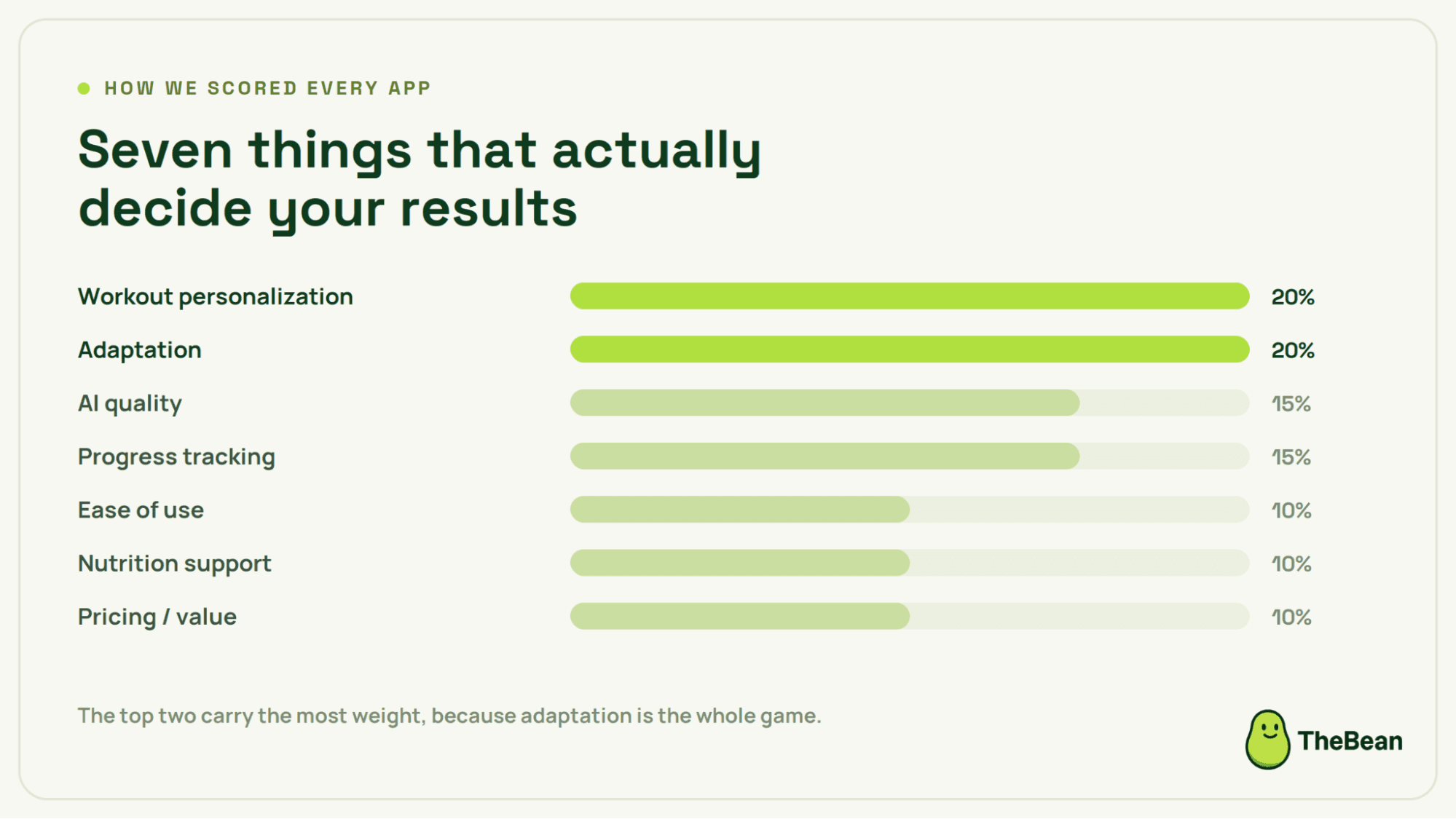
To keep it fair, we scored every app on the same seven things, the ones that actually decide whether you get results and stick around:
Criterion | What we were really asking | Weight |
Workout personalization | Is this built around you, or a template with your name pasted on? | 20% |
Adaptation | Does it change when you change, or freeze on day one? | 20% |
AI quality | Real reasoning, or a rules engine in a trench coat? | 15% |
Progress tracking | Can you actually read your trends, PRs, and volume? | 15% |
Ease of use | How fast and frictionless is logging in real life? | 10% |
Nutrition support | Does it touch the half of results that happen in the kitchen? | 10% |
Pricing/value | What you pay vs. what you actually get | 10% |
Each app earns a score out of 10 per category, rolled into an overall rating out of 10. Every score is shown so you can check our work and tell us where we're wrong. (And yes, we evaluated TheBean.ai on the identical rubric ✨)
5 Best AI Fitness Apps: A Quick Glimpse
Prices verified in June 2026 from each app's official pages. App-store and regional pricing can differ, so always confirm at checkout.
App Name | Best For | AI Features | Starting Price | App Rating |
Fitbod | Hands-off adaptive gym programming | Algorithmic workout generation, recovery/fatigue modeling, equipment-based swaps | $15.99/mo or $95.99/yr (7-day trial) | 4.8/5 |
Hevy | Free tracking + easy starts | Hevy Trainer (auto-generated programs + auto-progression), HevyGPT plan builder | Free; Pro $2.99/mo, $23.99/yr, $74.99 lifetime | 4.9/5 |
Strong | Minimalist, self-programmed logging | None (on purpose) | Free (3 routines); Premium $4.99/mo or $29.99/yr | 4.8/5 |
Freeletics | No-equipment/HIIT coaching | Adaptive AI "Coach" (feedback-driven), Daily Athlete Score | Training coach $1.54/week and training and nutrition bundle $1.92/week (billed every 3 months) | 4.6/5 |
TheBean.ai | Training + nutrition in one chat | Conversational dual-agent coach (workout + macros) that syncs and remembers | Free to start (web) | 4.8/5 |
5 Best AI Fitness Apps in 2026
1. Fitbod - The Best Overall for Gym Lifters
Best for: Intermediate and advanced lifters who want to stop programming and just train. Also anyone whose gym situation changes from one week to the next.
About Fitbod
Fitbod is the app most people picture when they hear "best gym app for muscle gain." It earned that the boring way: by actually doing the thing instead of just marketing it on the homepage.
You give it three things: your goal, your equipment, and how many days a week you'll realistically show up. Fitbod builds each session around your logged history, rotates muscle groups based on a fatigue/recovery model, and nudges the weight up when you're ready.
If you miss a week, it recalibrates instead of guilt-tripping you or if you are stuck in a gym with two dumbbells and a prayer, it rebuilds the workout on the spot.
That last bit is the whole point. Most apps "personalize" exactly once, then hand you the same plan until you quit. Fitbod keeps making decisions, which is the actual job of anything that wants to call itself a coach.
It also respects the one rule the entire gym runs on: progressive overload. Muscle only adapts when you keep asking it for a little more. Fitbod doesn't just write down your sets. It decides your next ones.
Pros
Genuinely adaptive session-to-session programming, not a fixed template
The best exercise swaps in the category when your equipment changes
A massive HD video library, so you're never standing there guessing what a movement actually looks like
Cons
The most expensive pick here, with no real free tier (you get a trial, not a free plan)
Zero nutrition support, which is half the equation it simply ignores
"Recovery" is inferred from your training log, not read from sleep or HRV. It's a smart guess, not a signal from your actual body.
Repetition is a recurring complaint. Independent reviews describe some generated sessions as generic or repetitive, and you'll find user reviews echoing it.
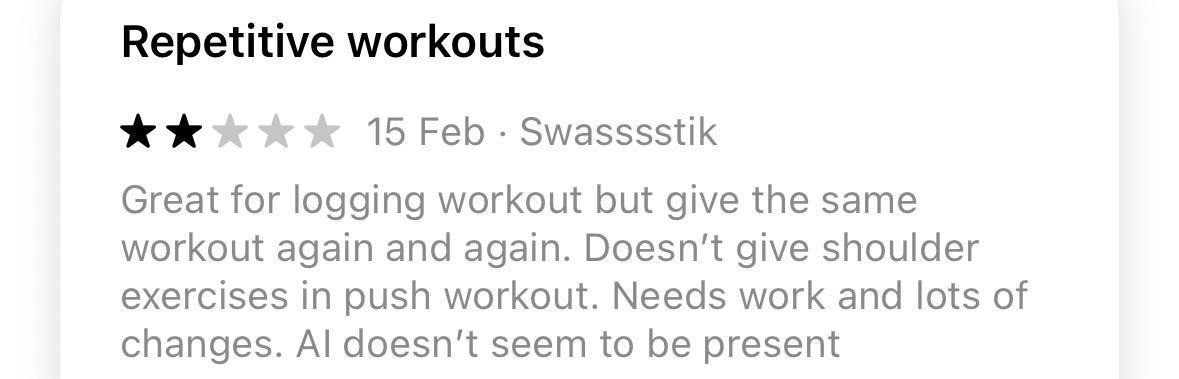
The variety is real, but you have to actively manage your settings to get it.
Pricing
$15.99/month or $95.99/year, with a 7-day free trial. You'll spot a few alternate App Store prices floating around too ($12.99/mo, $79.99/yr).
It's now HSA/FSA eligible, which quietly drops the real cost for a lot of US users.
AI capabilities
Smart, but not conversational.
Fitbod's engine reads your training history, fatigue, and equipment, then makes a genuinely good call on what you should do next. That part works.
What it can't do is talk. There's no asking why it programmed something, no telling it your shoulder feels tweaked today and watching it adjust. It reasons over your data in the background and hands you a finished plan. You take it or you tweak it manually.
Powerful autopilot. Not a coach you can argue with.
Verdict
If your only question is "what should I lift today, and is it hard enough to count?", nothing here answers it better. Fitbod wins Best Overall because adaptation is the entire game, and it's been winning that game since 2015.
Just walk in clear-eyed about what it isn't. It'll dial in your training and leave your diet completely up to you.
Scorecard:
Personalization | 9 |
Adaptation | 8 |
AI quality | 8 |
Tracking | 8 |
Ease of use | 8 |
Nutrition | 1 |
Value | 6 |
Overall: 7.3/10
2. Hevy - The Best Free App (and the One to Start On)
Best for: Beginners who want a foolproof free start, and budget-minded lifters who already know their program and just want it logged well.
About Hevy
Hevy spent years being refreshingly honest about what it was: not an AI coach, just the cleanest workout logger on your phone, with a social feed bolted on so you could post PRs and follow your friends. It launched in 2018 on that promise and grew it to 9M+ users and a 4.9-star rating.
Then, on February 18, 2026, it finally answered the AI question. Hevy Trainer now generates programs and auto-progresses your weights from session to session based on how your last sets went. There's also HevyGPT, a ChatGPT integration that drafts a routine from your goals and gear.
And the best part: it offers a free tier. You get unlimited workout logging, the full exercise library, and proper progress charts for exactly zero dollars. The caps only show up if you push it: four routines, seven custom exercises, three months of history.
For most people, that free version does everything they actually need.
Hevy figured out that the fastest way to win the category wasn't a smarter algorithm. It was removing the reason to pay at all, then earning a few bucks from the people who outgrow it.
Pros
The best free tier in fitness, full stop
Fast, genuinely pleasant logging with charts you'll actually read
The cheapest paid tier of any app here, plus a $74.99 one-time lifetime option
Native Apple Watch and Wear OS support, which is rarer than it should be
Cons
The AI is shallow. Hevy Trainer auto-progresses your weight, but it doesn't read your recovery, and HevyGPT will draft a plan without knowing a thing about what you logged yesterday
No nutrition support of any kind
The free-tier caps (four routines, three months of history) start to pinch if you run a complex split long-term
The social feed is great motivation for some people and pure noise for others. You'll know which camp you're in fast
Pricing
Free, and the free plan is the point. Hevy Pro runs $2.99/month, $23.99/year, or $74.99 once for lifetime access.
That's the most generous pricing in this entire roundup, and it isn't close.
AI capabilities
Real, but light. Hevy Trainer builds you a program and quietly bumps your weights when you're progressing, which is more than a logger does and less than a coach does. HevyGPT can spin up a routine from a text prompt.
Here's the ceiling, though. Neither one understands your week. Hevy Trainer reacts to the numbers you logged, not to the fact that you slept four hours or your elbow's been cranky. HevyGPT drafts in a vacuum, then forgets the conversation.
Helpful autofill. Not a coach with a memory.
Verdict
If you're new to lifting or just allergic to paying for software, start here. Hevy gives you more for free than some apps give you for $15, and the Feb 2026 AI additions finally close its biggest gap on paper.
Just set your expectations honestly. "Hevy Trainer" is a progression engine with good manners, not a coach reading your body. For most people, especially in year one, that's plenty.
Scorecard:
Personalization | 6 |
Adaptation | 6 |
AI quality | 6 |
Tracking | 9 |
Ease of use | 9 |
Nutrition | 1 |
Value | 9 |
Overall: 6.6/10
3. Strong - The Best Minimalist Workout Logger
Best for: Experienced lifters running a program they already trust (5/3/1, a hypertrophy block, something a coach wrote) who want a fast, clean logbook and nothing else getting in the way.
About Strong
Strong has one belief and it has never once flinched on it: think less, lift more.
No AI. No social feed. No nutrition. Just the quickest way to log a set and get back to your rest timer.
Launched in 2014, Strong has spent over a decade sanding down the logging experience until there's nothing left to remove. Open a session, tap in your weight and reps, move on. It's so fast it makes newer apps feel cluttered, which is why 5M+ lifters and a 4.9-star rating stuck around, including a fair number of powerlifters and coaches who tried everything else and came back.
Here's why Strong belongs in a roundup about AI apps: it's the control group. It's the one app here that flat-out refuses to pretend it's intelligent.
There's no quiz claiming to read your soul, no "smart" plan that's really a template. You bring the program, Strong remembers it, and that's the entire deal, and in a category full of marketing paint, the honesty is almost refreshing.
The catch is that honesty is also the ceiling. Strong won't tell you what to do, won't progress your loads, and won't notice you've stalled. If you don't already know how to program your own training, this isn't your app.
Pros
The fastest, cleanest logging experience in the category, full stop
Genuinely deep tracking: PRs, RPE, advanced charts, body measurements, and a muscle heat map so you can see what you've hit this week
A one-time lifetime purchase option, so you can pay once and never think about it again
Brutally honest about what it is, which is more than most of its competitors can say
Cons
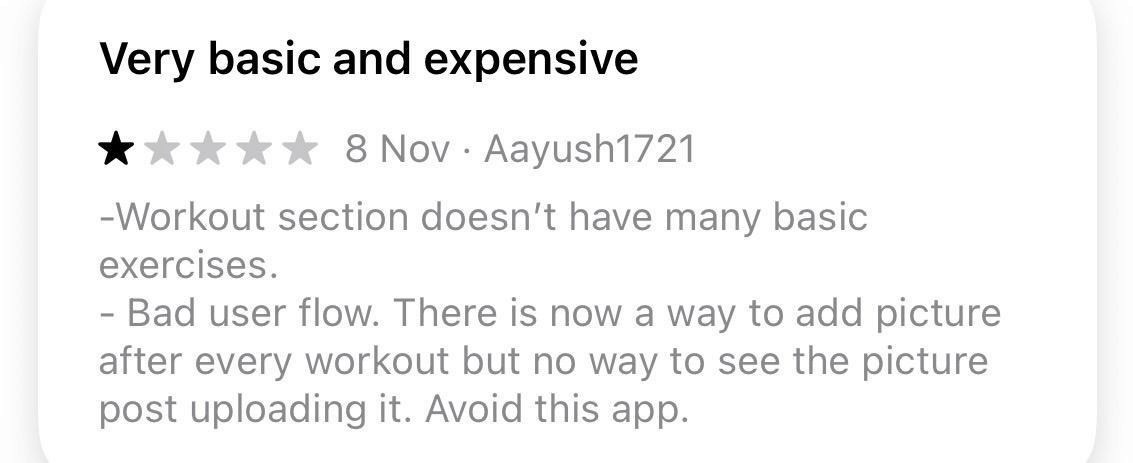
No AI, no workout generation, no adaptation. By design, but it's still a hard no if that's what you came for, and that’s what users say
iOS-first. The iPhone and Apple Watch apps are the best built, and the Android version has historically lagged on feature parity
The free tier is stingy. You're capped at three routines before it nudges you to pay
Zero nutrition support, and the interface, while clean, is starting to feel its age next to newer apps
Pricing
Free forever for basic logging, with the three-routine cap. Strong Premium runs $4.99/month or $29.99/year, and a lifetime option has historically been offered around $99.99.
For a tool you'll open every single training day for years, the lifetime price is the one to look at.
AI capabilities
There aren't any. And honestly, that's the most truthful line in this whole article.
Strong doesn't generate workouts, doesn't adapt, doesn't read your recovery, doesn't claim to. Where every other app on this list is racing to slap "AI-powered" on the box, Strong just shrugs and says you do the work.
So if you're shopping for intelligence, look elsewhere. But if you've ever been burned by an app that promised a brain and delivered a spreadsheet, there's something to be said for one that never promised the brain in the first place.
Definitely, not a coach and neither pretending to be one.
Verdict
As a workout logger, Strong is a 5 out of 5. As an AI fitness app, it's a 3.8, and that gap is the whole reason this article exists.
If you already know what you're doing in the gym and you just want the cleanest possible logbook, stop reading and download it. If you want something that actually decides anything for you, Strong will quietly let you down, because it was never trying to do that job.
Scorecard:
Personalization | 4 |
Adaptation | 2 |
AI quality | 1 |
Tracking | 8 |
Ease of use | 9 |
Nutrition | 1 |
Value | 6 |
Overall: 4.2/10
4. Freeletics - The Best Coach for Training Without a Gym
Best for: Beginners who want real hand-holding, travelers, and anyone training with little or no equipment. If your "gym" is a hotel room or a patch of floor, this is your app.
About Freeletics
Here's the rare AI fitness app that changes its mind as often as you do.
Built in Munich in 2013, Freeletics now counts 60M users and 450M+ completed sessions, and it's spent that time getting very good at one specific thing: coaching you when you don't have a gym.
Here's how it works. After every session, you rate how hard it felt. The Coach takes that feedback and reshapes your next week around it: easier if you're cooked, harder if you breezed through. You tell it your days, your time, your location, and what gear you've got, and it builds around your actual life instead of an idealized version of it.
The bodyweight and HIIT programming is the strongest here, and the 4K exercise videos (three angles, slow motion) are the best teaching tool of any app in this piece. It also has a Daily Athlete Score for readiness and an optional Nutrition Coach, putting it among the only two apps in this roundup that touch food at all.
The catch is focus. Freeletics shines without equipment and gets noticeably less sharp the closer you move to a loaded barbell. It also adapts off your self-reported effort, not wearable data, so the quality of the coaching tracks the quality of your feedback.
For a true beginner who wants to be taught instead of handed a plan and left to it, that combination makes it the best AI workout app for beginners in this roundup.
Pros
A coach that genuinely re-plans week to week, not a static plan with a countdown timer
The strongest bodyweight and HIIT programming here, plus 4K form videos you can actually learn from
Optional nutrition coaching, which most apps in this roundup don't offer at all
Works anywhere, with or without equipment, which is the whole pitch and it delivers on it
Cons
Not built for serious barbell strength. If you're chasing big compound numbers, look elsewhere
The adaptation is driven by self-report, not wearables or HRV, so it's only as good as your feedback
As a precise set-by-set logger for heavy gym work, it's weaker than Fitbod, Hevy, or Strong
The pricing is opaque and promotion-driven, which is the one genuinely annoying thing about it
Pricing
Freeletics offers two plans: Training Coach and Training and Nutrition Bundle
The Training Coach plan starts at $1.54/week and Training and Nutrition bundle starts at $1.92/week (billed every 3 months)
AI capabilities
A real adaptive coach, in a narrow lane. Freeletics actually changes your training based on how you respond to it, week after week, which is more than most of the "AI" apps here can say. That feedback loop is the genuine article.
The ceiling is twofold. First, it's reading your self-reported effort, not your body, so it can't catch the things you don't report. Second, the intelligence is tuned for bodyweight and HIIT, and it gets noticeably less sharp the closer you get to a loaded barbell.
It adapts. It just adapts best when you're not chasing a one-rep max.
Verdict
For training without a gym, nothing here beats it. Freeletics is also quiet proof of the thesis running through this whole article: a coach that adapts off simple, honest inputs will beat a static "optimized" plan every time.
Just match it to the right goal. If you want flexible, equipment-light training that bends around your week, it's excellent. If you want to grind heavy barbells with precise progression, you'll outgrow it fast.
Scorecard:
Personalization | 7 |
Adaptation | 7 |
AI quality | 7 |
Tracking | 5 |
Ease of use | 8 |
Nutrition | 6 |
Value | 5 |
Overall: 6.5/10
5. TheBean.ai - The Best for Training and Nutrition in One Chat
Best for: Lifters who are tired of running a workout app and a separate macro tracker that never talk to each other, and who want to adjust both by just typing a sentence.
About TheBean.ai
Now the part where we review our own app and try not to embarrass ourselves. 😬
Quick Note: we own this app but we scored it on the same rubric as everyone else, and you'll see below it didn't run away with the trophy.
TheBean.ai makes a bet none of the other four do: that your workout coach and your nutrition coach should be the same system, sharing one brain. It runs two conversational agents.
GymBro Bean handles training (your split, progressive overload, swapping an exercise the second your shoulder complains). Macro Bean handles food (your macros, protein-first meals built from stuff you'll actually eat, a weekly shopping list). They both read from one shared memory it calls your Locker, where your goals, measurements, injuries, and food preferences live.
The point of combining is simple. Train harder this week and your calorie target moves on its own. Want to change anything? You type it, like texting a coach who actually remembers you, instead of hunting through five settings menus.
That training-and-nutrition link is the most defensible thing here, because food is where most body-composition results actually happen, and it's the exact thing four of the five apps in this roundup ignore completely. The science isn't subtle: the ISSN puts the target for building and keeping muscle at 1.4 to 2.0 g of protein per kg of bodyweight, and a workout app that says nothing about that is solving half the problem.
Now the honest half.
TheBean.ai is the youngest and least proven app on this list. It's web-first with no native mobile app yet (early users keep asking for one, loudly). Its feedback wall is small, 4.8/5 from 340+ lifters, which is promising but tiny next to Fitbod's millions.
Pros
The only app here that genuinely fuses training and nutrition, with one shared memory across both
Properly conversational. You adjust your program or your meals in plain English, mid-thought
Pushes progressive overload and protein-first eating together, instead of leaving you to bolt the two halves together yourself
Cons
Early-stage and small. The track record just isn't there yet, and that's a real reason to be cautious
Web-first, with no native mobile app at the time of writing
No wearable or HRV integration
Pricing isn't published on the site yet, so you'll need to check the cost when you sign up
Pricing
You start free through the web app.
AI capabilities
The most conversational setup in this roundup, and the only dual-agent one. Two coaches, one memory, and you talk to both like humans.
Tell GymBro Bean your knee's acting up and it reworks the session. Tell Macro Bean you're sick of chicken and it rebuilds your meals. Because they share the Locker, a change on one side ripples to the other without you repeating yourself.
The honest limit is everything that comes with being new. No wearable data feeding the conversation, a smaller body of real-world usage than the veterans, and a web-only home for now.
A coach you can actually talk to. Just one that's still early in its career.
Verdict
It loses Best Overall to Fitbod on maturity and proof, and it should. Fitbod has a decade and millions of users; TheBean.ai has an interesting design and a few hundred testers.
But it's the only app here that treats your lifting and your eating as one connected problem, which is genuinely the right thing to be building. If that integration is what you've been missing, it's worth a look today. If you want a battle-tested veteran, the others have more road behind them. Ask us again in a year. 😉
Scorecard:
Personalization | 7 |
Adaptation | 7 |
AI quality | 8 |
Tracking | 5 |
Ease of use | 6 |
Nutrition | 8 |
Value | 7 |
Overall: 6.1/10
What Makes a Great AI Fitness App?
After all that testing, a great AI fitness app comes down to five things, in rough order of how much they matter.
1. Adaptation beats personalization
A one-time "personalized" plan is just a template with your name on it. What you want is a system that changes when you change: when you're sore, when you miss a week, when you stall.
Remember that strength response ranged from −8% to +60% on identical programs. The fix is: a system that adjusts the stimulus, which is exactly what reduced the number of non-responders in one crossover study.
2. Progressive overload, handled automatically
Whatever the marketing says, continued gains require progressively greater demand on the muscle (Source).
A great app either applies it automatically or makes applying it yourself effortless. If you have to remember to add weight on your own, the app isn't doing its job.
3. Recovery awareness, honestly framed
This is where most apps oversell. Recovery-guided training is real, but it isn't magic.
A meta-analysis found it reliably improves vagal-HRV markers and produces fewer non-responders, while a second meta-analysis found only a small, non-significant edge on actual performance versus a smart predefined plan.
So an app that "reads your recovery" is a nice-to-have, not a results cheat code. Fitbod and Freeletics approximate recovery without HRV and do fine.
4. Nutrition integration
The biggest blind spot in the category.
Four of the five apps here do nothing for your diet, even though protein intake is one of the most established levers for body composition. An app that ignores food is solving half the problem and charging you full price.
Long-term coaching that keeps you in the game
The unglamorous truth below.
The unglamorous one that beats all the rest. Only 18% of beginners are still training at six months, and the strongest predictor of who lasted was consistency in the first 28 days.
The best app isn't the one with the cleverest periodization but the one you still open in week five.
Most Fitness Apps Still Aren't Truly Personalized
Here's the dirty secret the category doesn't put on its landing page: most "AI personalization" happens exactly once.
You log in, the app generates a plan, and then... that's mostly it. The plan sits there, static, while your life does not.
You sleep badly. You travel. You get strong on bench and stall on squat. A genuinely personalized system would respond to all of that. A template just waits for you to follow it or quit.
You can sort this whole category into three honest buckets:
Loggers (Strong, free Hevy): they remember what you did. Zero personalization, and they don't pretend otherwise.
Generators (Fitbod, Hevy Trainer): they create and progress a plan algorithmically. This is real, and it's most of what people call "AI fitness" today.
Adaptive coaches (Freeletics, TheBean.ai): they take ongoing input (your feedback, your messages) and re-plan. The smallest bucket, and the most interesting.
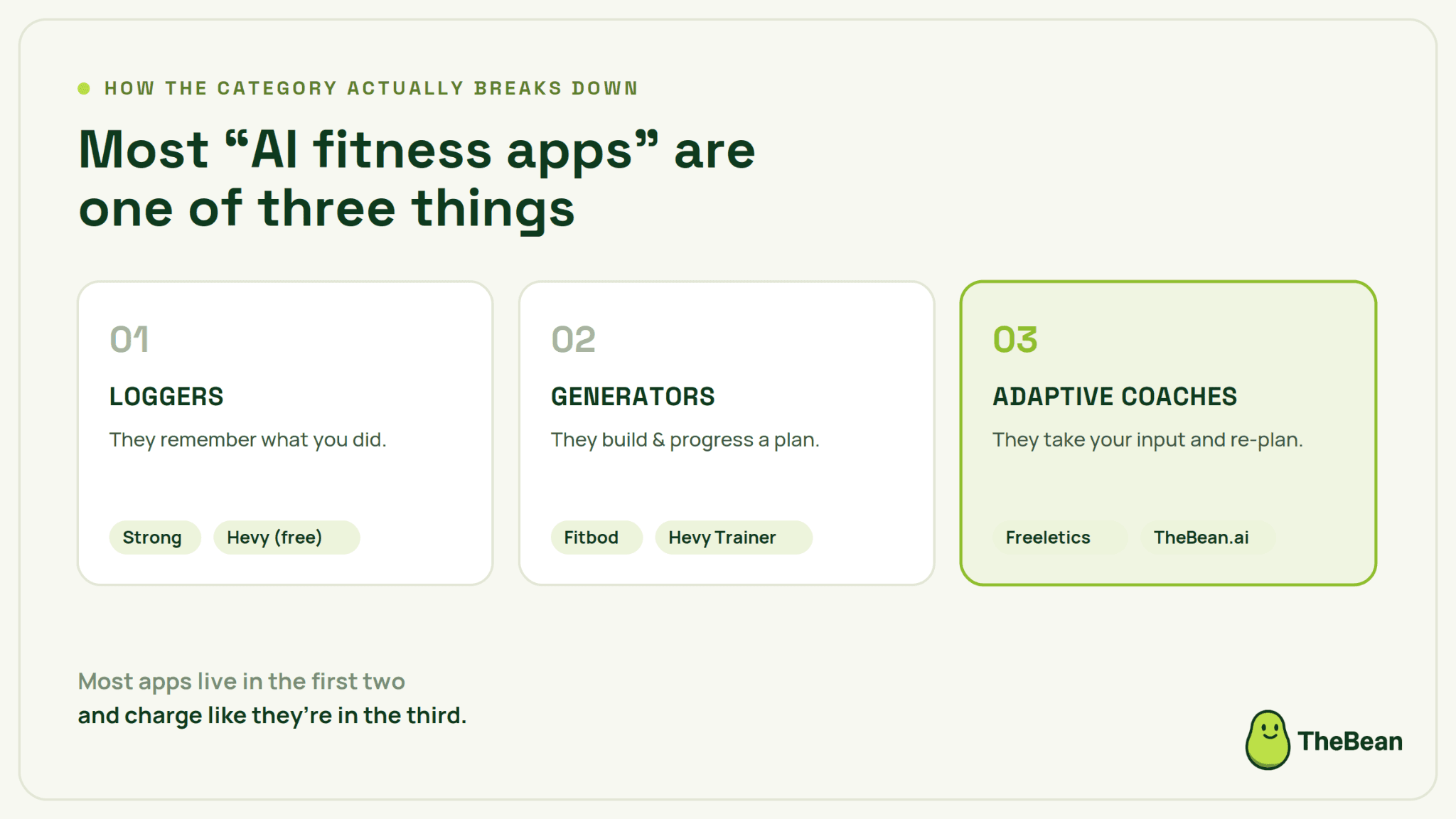
The marketing blurs these three on purpose, because "we log your sets" sells worse than "AI-powered personalized coaching."
When you're selecting, the only question that cuts through it is: what does this app do between my workouts? If the answer is "nothing until you open it again," you bought a logger. That might be all you need. Just don't pay coach prices for it.
How AI Fitness Coaching Is Changing in 2026
Four shifts worth watching, minus the hype.
From generating to talking: The last wave generated a plan. This one lets you argue with it. Conversational coaching (HevyGPT, TheBean.ai's chat agents) is replacing settings menus, and it's the biggest UX change in the category.
Wearables, with realistic expectations: More apps are pulling sleep, heart rate, and HRV. Good, as long as you remember the data reduces non-responders more than it boosts your one-rep max. Helpful, not miraculous.
Nutrition finally entering the chat: The smartest move in 2026 isn't a flashier workout generator. It's linking training to eating, because that's where results compound. Expect more apps to copy the idea.
AI as the accountability layer: The quiet one that matters most. Since only 18% of beginners last six months and early consistency decides the rest, the app that wins won't have the cleverest periodization. It'll be the one that gets you through month one.
Our Recommendation
No single app wins for everyone, so here are the picks by what you actually want.
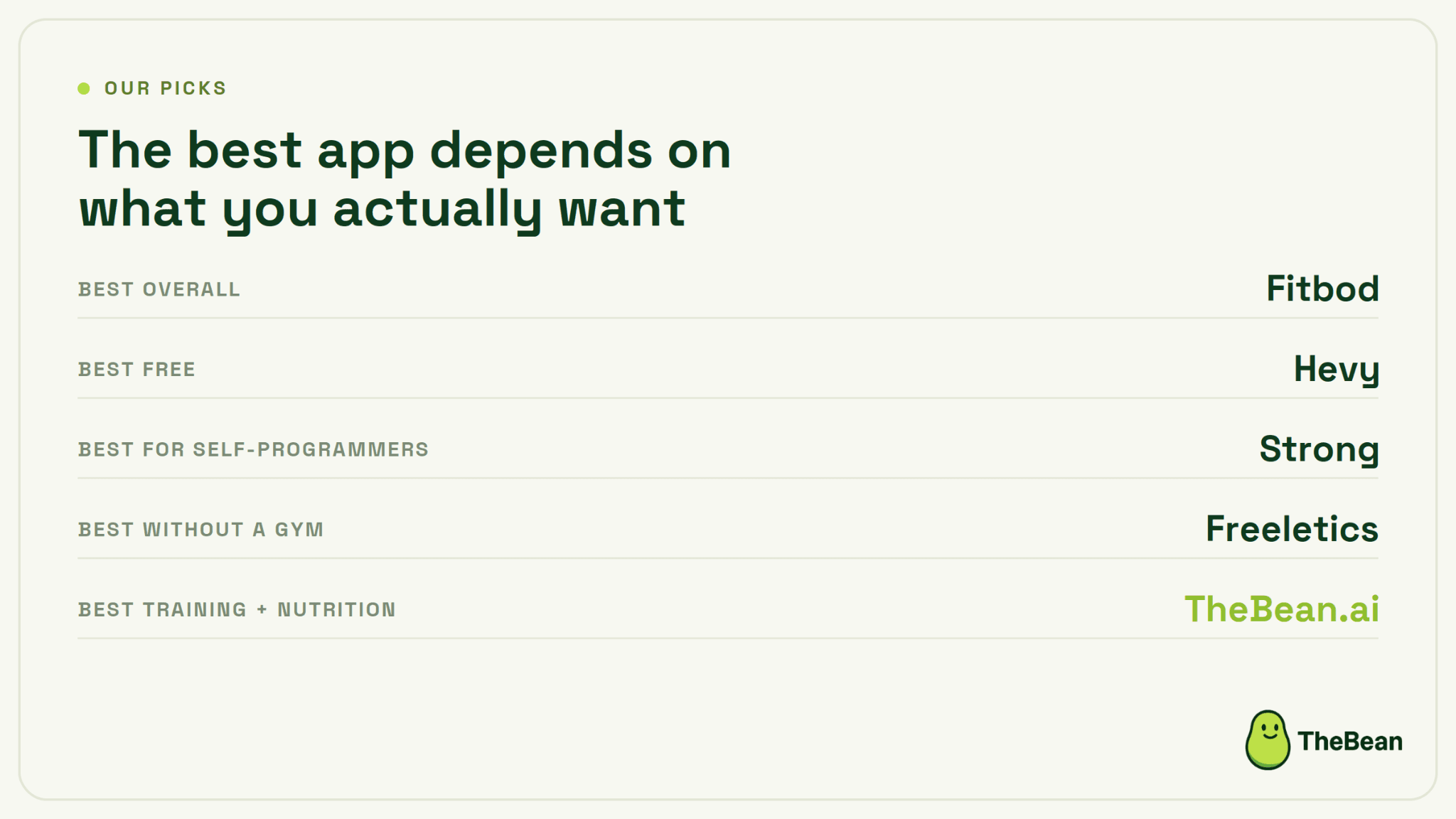
Best Overall: Fitbod. The most mature adaptive engine for gym lifters. If you want to stop planning and start progressing, this is it.
Best for Beginners: Freeletics. Full hand-holding, world-class form videos, real week-to-week adaptation, and it works with no equipment while you learn the ropes.
Best for Strength Training: Strong. For the powerlifter or self-programmer who wants the fastest, cleanest logbook on iOS and no AI getting in the way.
Best Free Option: Hevy. The free tier does more than some apps' paid tiers, and Hevy Trainer adds real progression at no cost beyond Pro.
Best for Adaptive Coaching (Training + Nutrition): TheBean.ai. The only app here that coaches your lifting and your eating as one connected conversation. Early, but pointed at the right problem.
Frequently Asked Questions (FAQ)
1. What is an AI fitness app?
An AI fitness app uses algorithms (and increasingly, conversational models) to generate, adjust, and coach your workouts and sometimes your nutrition based on your data, instead of handing everyone the same fixed plan. The strength of the "AI" varies enormously, from simple rules engines to coaches you can chat with.
2. Are AI workout apps effective?
Yes, AI workout apps are effective when they apply real training principles. Progressive overload drives strength and size gains, and apps that automate or simplify it work well. But effectiveness depends far more on consistency than cleverness: only 18.1% of beginners were still training at six months in one large 2026 study.
3. Can AI replace a personal trainer?
Well, for programming, progression, and logging it can. However, for hands-on form correction, real-time spotting, and the human accountability of someone expecting you at 6 a.m., not yet. The best use today is a hybrid: AI handles the plan and the data; a human (or the gym mirror) checks your technique.
Treat the best AI personal trainer app as the planning-and-data half of the job, and a human as the form-and-accountability half. That split is where the results actually live.
4. What is the best AI fitness app for muscle gain?
Fitbod, for most gym lifters, because it automates progressive overload and adapts to your recovery and equipment. If you want nutrition handled alongside training (and hitting 1.4–2.0 g/kg of protein is half the muscle-gain equation), TheBean.ai is worth a look.
5. What is the best AI fitness app for fat loss?
Fat loss is mostly a nutrition and consistency problem, so prioritize an app that supports both training and diet. Freeletics (with its nutrition add-on) and TheBean.ai (with integrated macros) are better suited than pure loggers like Strong.
6. Can AI help with fat loss?
Yes, it helps by keeping you consistent and keeping your calorie and protein targets honest as your training changes. The body composition wins come from adherence over months, not from any single feature.
7. Are AI workout generators worth it?
If you don't know how to program your own training, absolutely. A generator like Fitbod or Hevy Trainer saves you from analysis paralysis. If you already run a solid program, a generator is overkill and a clean logger like Strong is better value.
8. Is a free fitness app good enough?
For many people, yes. Hevy's free tier covers unlimited logging and progress tracking, which is genuinely all a self-programmed lifter needs. You pay up when you want adaptation, nutrition, or deeper analytics.
9. Do I need an app that reads my HRV or wearable data?
Well, it's a nice-to-have but not necessary. Recovery-guided training reliably improves HRV markers and reduces non-responders, but its edge on raw performance over a smart fixed plan is small. Don't pay a premium for HRV alone.
10. Why do people respond so differently to the same program?
Individual variability is huge and not fully explained by age, sex, or even muscle fiber type. Studies show strength responses ranging from +17% to +47% and even −8% to +60%on identical training. This is the core argument for adaptive apps over static plans.
11. Which app is best if I keep quitting after a few weeks?
Pick the one with the lowest friction that you'll actually open. Since early consistency is the top predictor of long-term adherence, a free, frictionless app you use daily beats a brilliant one you abandon. The best app is the one still on your home screen in week five.
12. Are these prices accurate?
The prices were verified in June 2026 from each app's official pages, but subscription pricing varies by platform, region, and promotion (Freeletics especially). Always confirm the final number at checkout.


