7 Best Fitbod Alternatives for Muscle Growth in 2026

Written By:
Pragati G.
Content Manager @ TheBean.ai

Reviewed By:
Algirdas S.
Founder @ TheBean.ai
Expert Verified


The 30-Second Answer
If you don't want to go through the complete breakdown, here's a quick 30-second glimpse of which Fitbod alternative fits which lifter:
If you want the closest upgrade to Fitbod: Alpha Progression. It generates AI plans and handles progressive overload like Fitbod does, but it shows you the logic and costs a fraction of the price.
If you mostly want to track your own training: Hevy. The best free tier in fitness, clean logging, and a social feed for accountability. The safest, cheapest switch for most people.
If you'd rather run a proven program than trust an algorithm: Boostcamp. Thousands of free coach-written programs (5/3/1, GZCLP, nSuns) plus full tracking, with no paywall on the essentials.
If you're chasing a bigger squat, bench, and deadlift: JuggernautAI. The most genuinely coached app here, built by an elite powerlifter. Expensive, and worth it if strength is the whole goal.
If you train at home or without much equipment: Freeletics. Real adaptive coaching for bodyweight and conditioning, with the best form videos of the bunch.
If you want simplicity above all: Strong. The fastest, cleanest logger on iOS. No AI, on purpose.
If you want training and nutrition handled in one place: TheBean.ai. The only option here that generates both your workouts and your meals from shared data. It's the newest and least proven, and yes, we make it.
The full reviews, scores, and the apps that beat Fitbod outright are below.
You already know why you're here. 😉
Either your Fitbod subscription renewed again, and you're tired of paying $95.99 a year for workouts that started repeating themselves around month three, or you're still on the fence, comparing it against other apps before committing.
Well, whichever group you’re in, the reasoning rarely changes.
The complaints that send people looking for a Fitbod alternative are remarkably consistent: the subscription keeps climbing with no free tier, the exercise selection turns repetitive, the customization is thinner than you'd expect, and for an app that wears the "AI" badge so proudly, there's no coaching you can actually talk to.
Fitbod generates a workout and then steps back. It doesn't adapt deeply to your recovery, your feedback, or the week you're actually having.
None of that is a secret, and none of it is unfixable. There are cheaper ai personal trainer apps, free ones, and a couple that coach better than Fitbod does.
We tested seven Fitbod alternatives for muscle growth specifically, trained with each for about a month, and verified pricing from the source in June 2026. This guide covers the most-recommended alternatives based on personalization, tracking, AI coaching, progression systems, and overall value, our own app included and held to the identical rubric.
Let’s get started! ✨
How We Tested Fitbod Alternatives
Most "we tested apps" articles were written by someone who opened the App Store, skimmed the screenshots, and reworded the marketing copy.
Honestly, that's not a test.
The major testing is done by Algirdas, CEO @TheBean AI who's spent 15 years in the fitness industry coaching fitness enthusiasts and watching workout apps arrive every January convinced they'd cracked the code.
We used each app the way you would. Set it up, trained with it, and paid attention to what it actually did once the new-toy feeling wore off.
In practice that meant living in each one for around 30 days, logging a dozen-plus sessions, long enough to get past the honeymoon and into the stretch where an app either keeps making smart calls or starts recycling the same workout.
We scored every app out of 10 on the seven things that actually decide whether you build muscle and stick around. The weights reflect what matters for muscle growth specifically, which is why personalization and tracking carry the most.
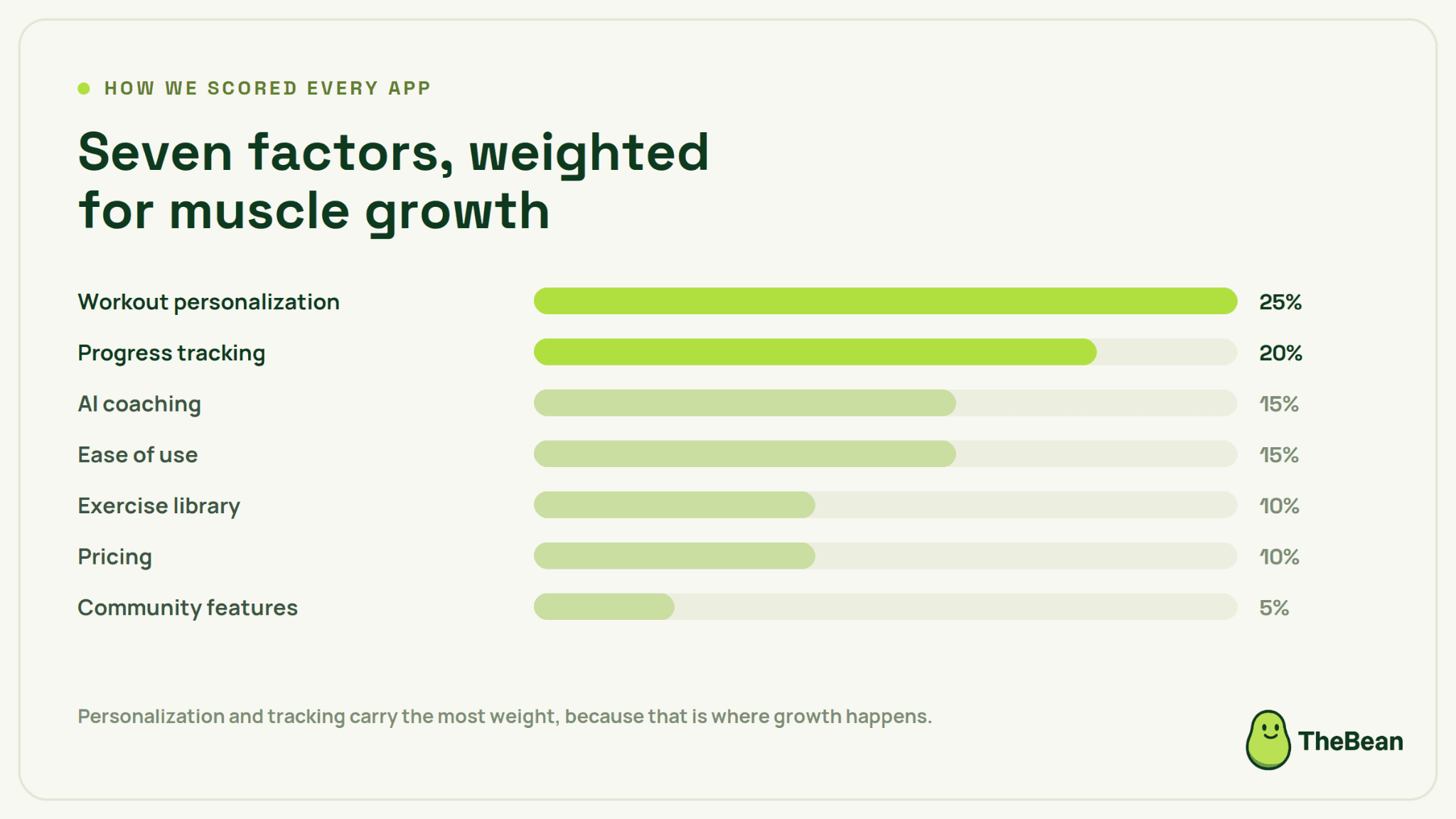
Factor | What we were really asking | Weight |
Workout personalization | Built around your goals and body, or a template with your name on it? | 25% |
Progress tracking | Can you actually read your volume, PRs, and trends? | 20% |
AI coaching | Real adaptation and reasoning, or a static plan in a smart costume? | 15% |
Ease of use | Fast, frictionless logging in real life | 15% |
Exercise library | Range, quality, and form guidance | 10% |
Pricing | What you pay versus what you get | 10% |
Community features | Accountability, sharing, social pull | 5% |
Each app earns a score out of 10 per factor, weighted into one overall out of 10. Every number is shown so you can check our work.
Full disclosure, stated up front because it matters: TheBean.ai publishes this guide. We put it through the same rubric as everything else, and since it's still early, it scored like something that's still early. The number's in there with the rest. Judge it for yourself.
Quick Comparison Table: 7 Best Fitbod Alternatives
Pricing verified June 2026 from official sources. App-store and regional prices vary, so confirm at checkout.
App | Best For | Free Plan | AI Features | Starting Price | App Rating (App Store - as per June 2026) | Score |
Alpha Progression | Muscle-building progression | Yes (limited) | High: AI generator, RIR, deloads | ~$9.99/mo or ~$79.99/yr | 4.9/5 (32 ratings) | 7.9 |
Hevy | Tracking muscle building + best free tier | Yes (generous) | Low–Med: Hevy Trainer, HevyGPT | Free; Pro $2.99/mo | 4.9/5 (7.4k ratings) | 7.7 |
JuggernautAI | Powerlifting & strength athletes | No (2-week trial) | High: adaptive periodization | $34.99/mo | 5/5 (7 ratings) | 7.4 |
Boostcamp | Free hypertrophy programs | Yes (full app) | Low: curated, not generated | Free; Pro $4.99/mo | 4.9/5 (225 ratings) | 7.0 |
Freeletics | Home & minimal-equipment training | Limited | Med: adaptive (self-report) | Training Coach - $1.54/week (billed every 3 months) | 4.6/5 (5.3k ratings) | 6.7 |
TheBean.ai | Training + nutrition in one place | Yes (to start) | Med: workout + meal generators | Free to start | NA | 5.9 |
Strong | Simplicity and clean logging | Yes (3 routines) | None | Free; Premium $4.99/mo | 4.8/5 (1.9k ratings) | 5.5 |
Fitbod (the app you're leaving) | On-demand workout generation | No (3-workout trial) | Med: dynamic generation | $15.99/mo | 4.8/5 (940 ratings) | 7.1 (ref) |
Yes, Fitbod scores 7.1 - clearly not a bad app, just an expensive one with some specific gaps, and each of the alternatives above fix a different gap.
Is Fitbod Still Worth It in 2026?
Well, that completely depends on what you actually want.
As a workout generator, Fitbod is still good. It scored 7.1 on our rubric, which puts it ahead of half this list. If you're new, hate planning, and want an app that hands you a session and gets out of the way, it earns its keep.
The problem is the price-to-gap ratio. You're paying $15.99 a month for generation, not coaching, with no free tier to fall back on and progression that happens in the dark. For a beginner, fine. For anyone two years in who wants transparency, deeper analytics, or food in the mix, you're overpaying for a product that stopped matching your goal.
So, worth it for the first year, harder to defend after that. If any single gap on this list bugs you, one of the alternatives above fixes it cheaper.
Why People Look for Fitbod Alternatives
Fitbod has 15M+ downloads and a 4.8 rating. The people leaving it mostly liked it. They just hit one of five specific gaps once they got serious about building muscle.
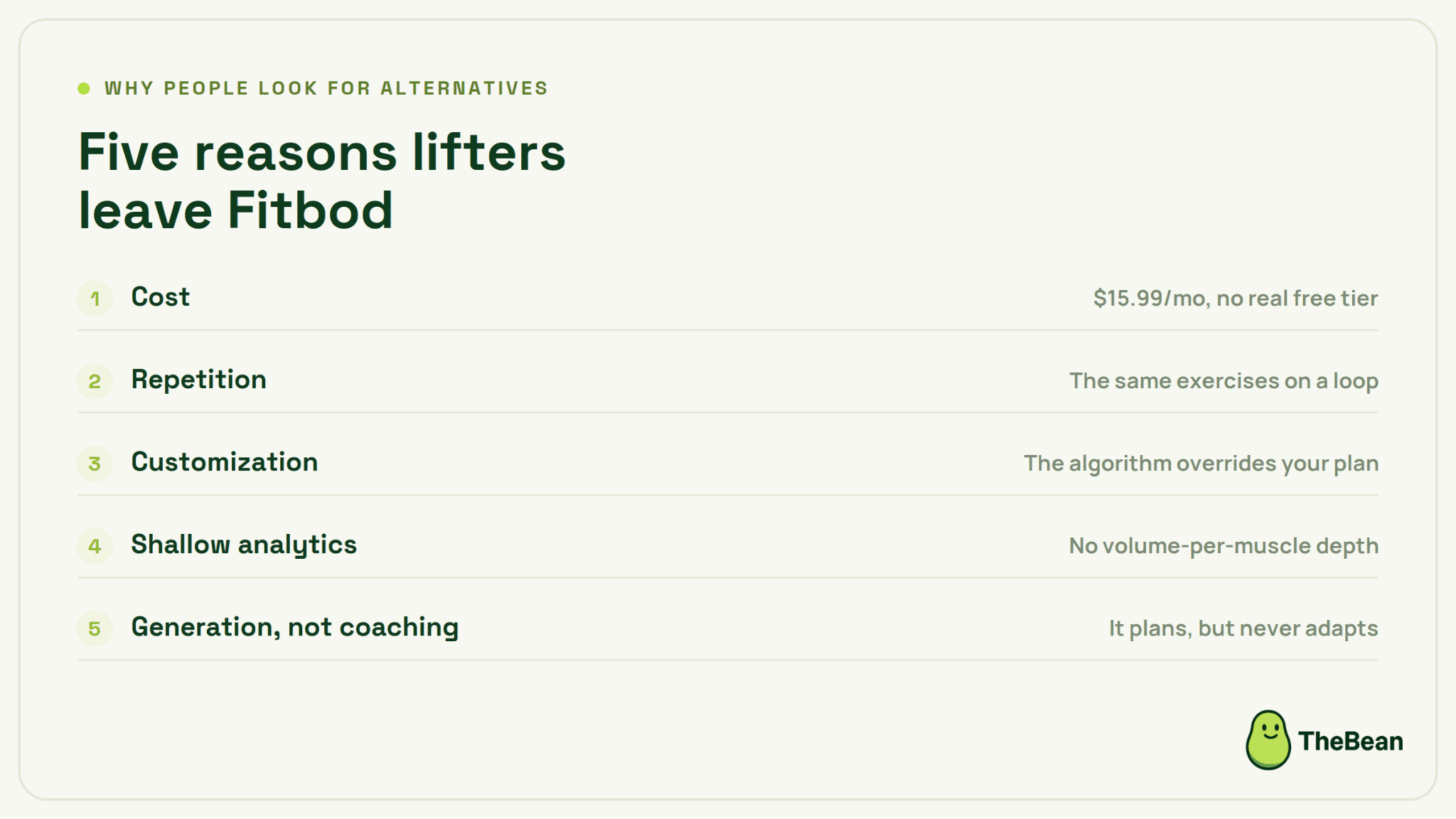
1. The Cost
Fitbod runs $12.99 to $15.99 a month, or $79.99 to $95.99 a year, after a three-workout trial, with no permanent free tier to fall back on.
That's a lot to pay indefinitely when Hevy and Boostcamp do the core job for free, and it's usually the first reason people start looking for other apps like Fitbod around.
2. Repetitive Workouts
Well, this is one of the loudest complaints, and it matters more for growth than it looks.
Hypertrophy rewards hammering the same key lifts and adding load over time, but lifters report Fitbod recycling the same exercises until sessions blur together.
One App Store review puts it plainly: "Great for logging workouts but gives the same workout again and again. Doesn't give shoulder exercises in push workout... AI doesn't seem to be present."
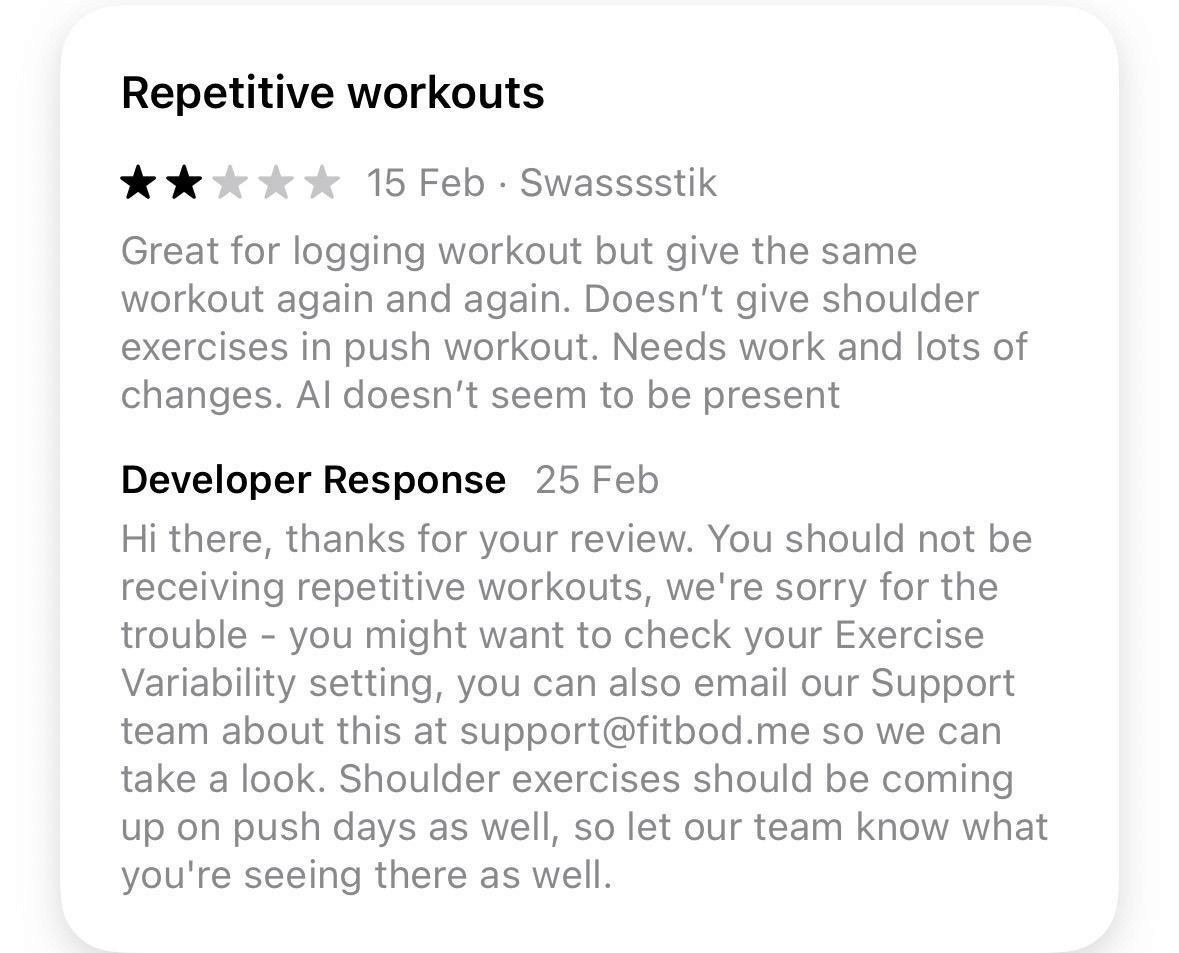
The variety lives in the settings, but you have to dig for it.
3. Limited customization
Fitbod is built to remove decisions, which helps right up until you want to make one.
Run a specific split or a hypertrophy block with set exercises in a set order, and the algorithm keeps steering you back toward its own picks. Lifters who already know what they want to train tend to feel boxed in.
4. Shallow progression analytics
For muscle, the numbers that matter are weekly volume per muscle group and whether your top sets are trending up.
Fitbod stores your history but doesn't surface that depth the way Alpha Progression's volume-per-muscle charts do. You can see what you lifted without easily seeing whether you're actually progressing where it counts.
5. Generation without coaching
The deepest reason, sitting under all the others. A workout generator produces a session and stops. An adaptive coach reads how you responded, explains the plan, and adjusts the next block on purpose.
Fitbod's progression happens quietly in the background, so when your bench climbs you don't know why, and when it stalls you don't know what to change. That’s fine for a beginner but acts as a wall for someone two years in and chasing real size.
Other reasons:
There’s no conversation. Fitbod reasons over your data and hands you a finished plan. You can't tell it your shoulder feels off today and watch it adjust the session. As one 2026 comparison put it bluntly, Fitbod has no conversational AI and no wearable data feeding its programming decisions. It's powerful autopilot, not a coach you can argue with.
It ignores the diet. Fitbod does nothing for your nutrition. For a muscle-growth goal, that's half the job missing, and we'll come back to why that matters more than any feature on the workout side.
Spend time in r/Fitness or r/naturalbodybuilding and the same arc repeats: people credit Fitbod for getting them started, then move on once they want more control, deeper data, or actual coaching.
That migration is what the rest of this guide maps.
The clean way to think about leaving Fitbod: you're probably not leaving because Fitbod is bad.
You're leaving because a generator and a coach are two different products, and you may have bought the wrong one for what you actually want. Sort the alternatives into three buckets and the whole category gets simpler:
Loggers (Strong, free Hevy): they remember what you did. Zero personalization, no pretense.
Generators (Alpha Progression, Hevy Trainer, Fitbod itself): they build and progress a plan algorithmically. This is most of what people mean by "AI workout app."
Adaptive coaches (JuggernautAI, Freeletics, TheBean.ai): they take ongoing input and genuinely re-plan. The smallest bucket, the most interesting one.
Pick the bucket first. Then pick the app.
Why Is Fitbod So Expensive?
Fitbod charges $12.99 to $15.99 a month with no permanent free tier, and the honest answer is: because it can.
It sits in the premium generator lane, sells convenience, and never has to compete on price the way trackers do. You're paying for on-demand workout generation and recovery estimates, not a coach who adapts to your week.
Compare that to Hevy at $2.99 or Boostcamp at free, both doing the core job, and the math stops working. Fitbod's price reflects its ambition, not its gaps. That tension is what drives this whole list.
What Reddit Users Recommend Instead of Fitbod
If you've gone down the r/Fitness or r/weightroom rabbit hole, you've seen the same names surface.
The most consistently recommended Fitbod replacements are Hevy (for people who just want clean tracking), Strong (for self-programmers), Alpha Progression (for lifters who want a real hypertrophy generator at a lower price), and Boostcamp (for people who want free, proven programs from named coaches instead of an algorithm's guess).
The complaints driving those recommendations are consistent: pricing, repetitive recommendations, a wish for a real free tier, and a hunger for genuine long-term progression rather than session-by-session generation.
The throughline is a preference for named-methodology programs over algorithmic session generation, which is exactly the gap Boostcamp and Alpha Progression fill.
You can also refer to this Reddit thread.
7 Best Fitbod Alternatives in 2026
1. Alpha Progression - Best Overall For Muscle Growth
Best for: Lifters who want Fitbod's "tell me what to do" convenience, but transparent, science-based, and a fraction of the price.
About Alpha Progression
Alpha Progression is the app that quietly does what Fitbod promises. This German-built app calls itself "the best muscle-building app to plan and track your workouts," and it largely earns it.
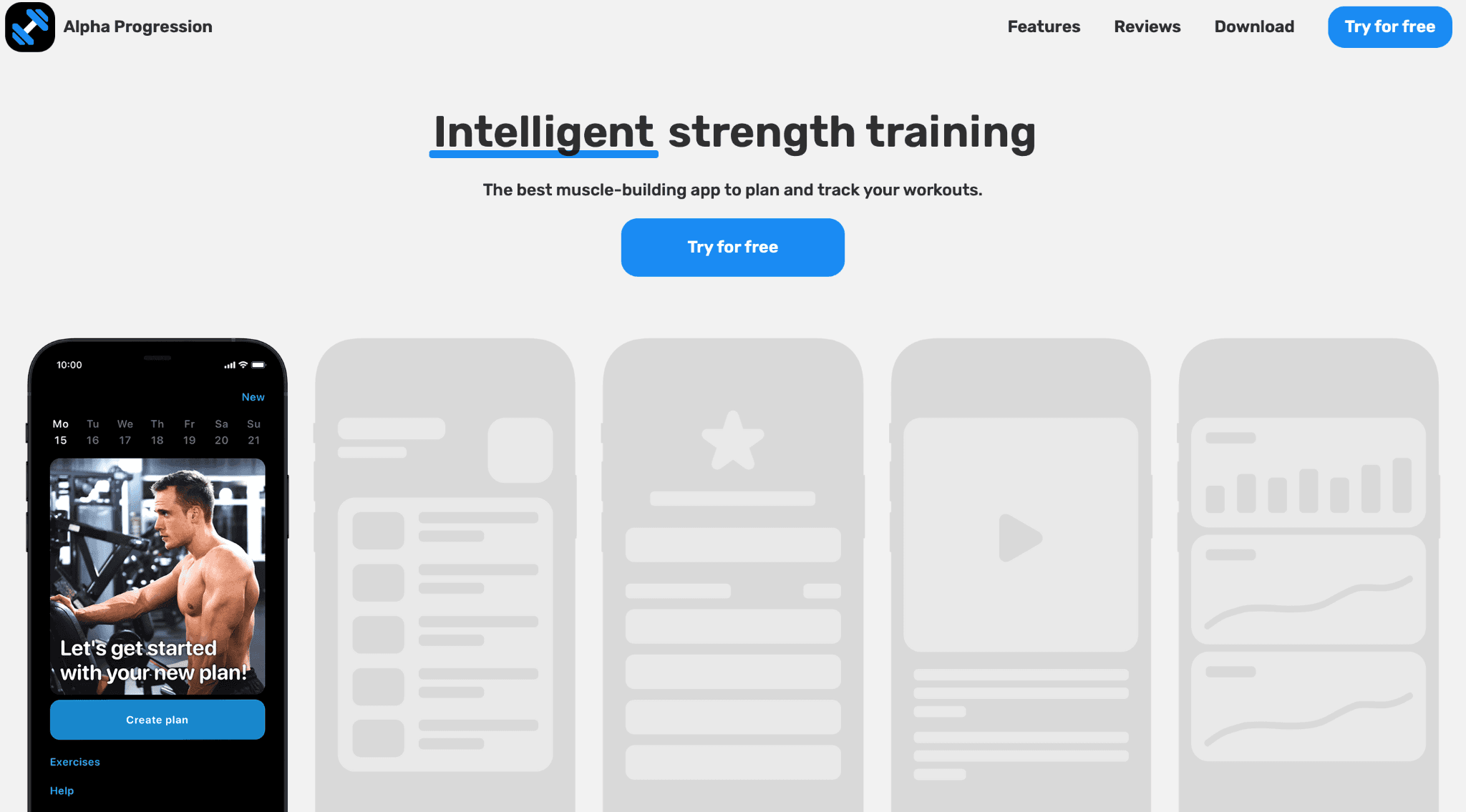
Its plan generator builds a program around how often you train, how long you've got, which muscles you want to prioritize, and the equipment you actually have. The programming leans on current meta-analyses and literature reviews in exercise science rather than vibes, and you can tweak any plan or build one from scratch.
The part that matters most for growth is the progression. For every set, Alpha Progression gives you a specific weight and rep recommendation by analyzing your past sessions and the one you're in right now. Hit your targets and it pushes you. Stall and it adjusts. You can layer on RIR tracking, periodization, and scheduled deloads when you're ready for them.
It also does something almost no other app bothers with: it grades exercises. Each of the 550+ exercises (all with video) gets an evaluation based on range of motion and stability, so you can see why a given movement is a good muscle-builder, not just that it exists. The charts then let you track volume, sets, and RIR per muscle group, which is the data that actually tells you whether a muscle is growing.
The difference from Fitbod comes down to transparency. Fitbod decides in the dark. Alpha shows you the logic, and over a few weeks it teaches you to program for yourself. It's widely rated one of the best weightlifting apps going.
Pros
A science-based plan generator with genuinely transparent, per-set progression
Exercise evaluations and volume-per-muscle charts that teach you, not just track you
550+ exercises with video, equipment-adaptive, works offline
One of the cheapest serious training apps anywhere
Cons
The interface assumes you know some training terms (RIR, volume, periodization), which can intimidate beginners
No nutrition, cardio, or mobility content
The plan generator and progression recommendations sit behind the Pro paywall
Pricing
The free tier (14-day free trial) covers logging and the exercise database. Pro runs about $12.99/month or roughly $79.99/year (often discounted), with occasional lifetime deals. That's well under Fitbod for arguably smarter, more transparent programming.
AI & personalization
A science-based plan generator that builds your program from your training frequency, target muscles, and available equipment.
Per-set weight and rep recommendations that adapt to your logged performance.
Optional RIR tracking, periodization, and auto-scheduled deloads.
Exercise evaluations that grade each movement for muscle-building.
It's an algorithm rather than a chatbot, and it shows its reasoning instead of hiding it.
Who should skip it?
Total beginners who want maximum hand-holding, and anyone who needs nutrition, cardio, or classes in the same app.
Verdict: If your reason for leaving Fitbod is price, repetition, or the black-box feeling, this is the most complete one-to-one upgrade on the list, and the best pure muscle-building pick.
Scorecard:
Personalization | 9 |
Tracking | 9 |
AI coaching | 8 |
Ease of use | 6 |
Exercise library | 8 |
Pricing | 8 |
Community | 3 |
Weighted overall | 7.9/10 |
2. Hevy - Best for Tracking Your Muscle-Building
Best for: Lifters who already know their program and want the cleanest, cheapest way to log it, with a social feed for accountability.
About Hevy
Hevy is the app most lifters mean when they say "I just want to log my workout."
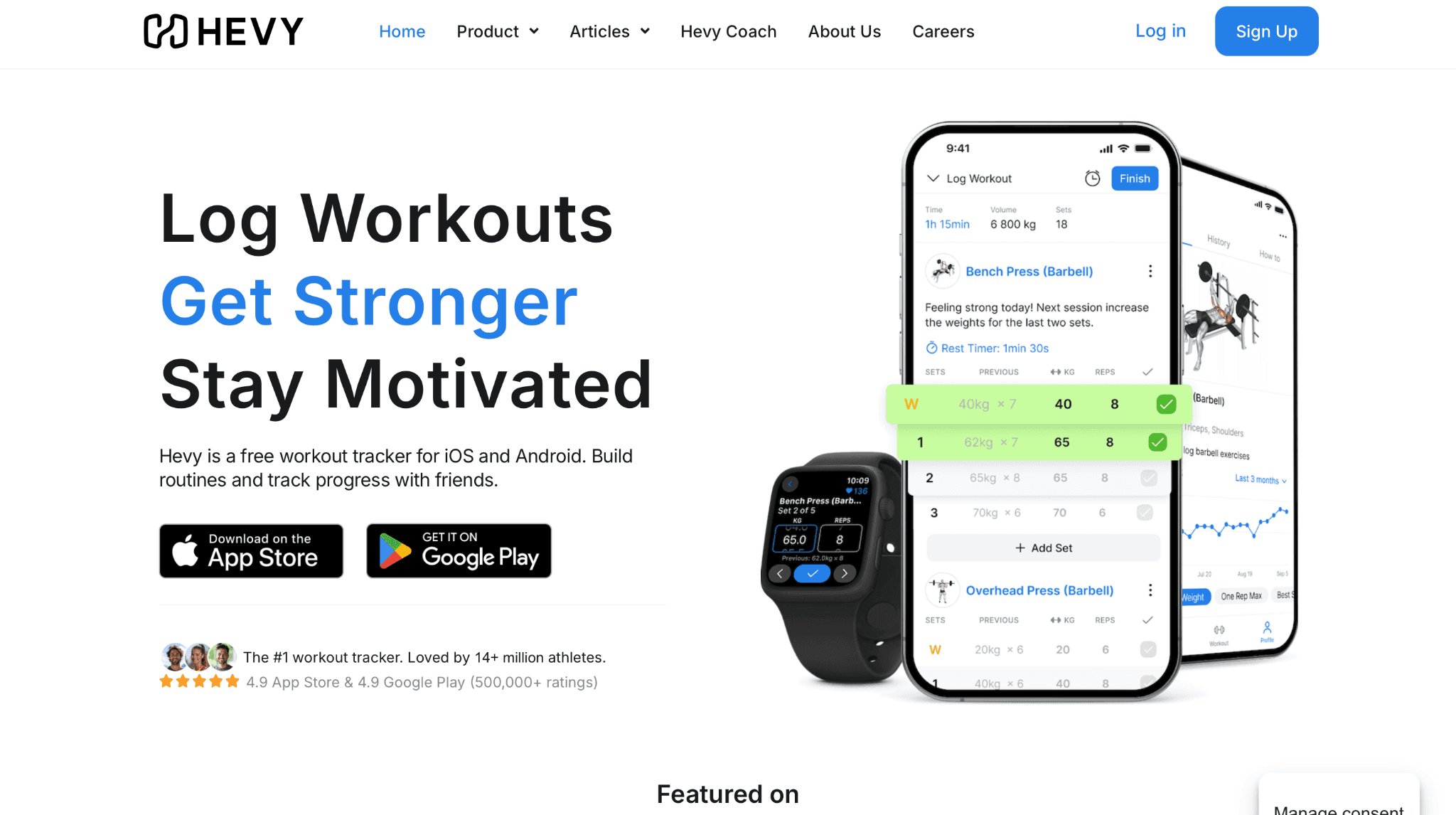
Hevy is the friendliest logger in the category and a community to go with it, and it's now used by 14+ million athletes at a 4.9 rating (279k+ App Store and 228k+ Google Play ratings). It earned that by being fast, clean, and genuinely pleasant to use mid-set.
The free tier is the headline. You get unlimited workout logging, the full exercise library with video demos, a routine planner, rest timers, warmup/drop/failure set marking, and the progress tools that actually matter for muscle: advanced per-exercise charts, personal records, a 1RM calculator, and complete exercise history.
The only real caps (four routines, three months of history) bite mainly if you run a complex split long-term, and even then Pro is cheap.
For building muscle, that tracking is the point. Progressive overload only works if you can see whether your top sets are climbing, and Hevy's charts make that obvious at a glance. There's a social feed too, which sounds gimmicky until it's the thing that drags you to the gym on a Tuesday.
What Hevy didn't used to do was tell you what to lift. Hevy Trainer changed that in February 2026, building programs and auto-progressing your weights. It's handy, but it doesn't read your recovery or think about your week. Best tracker out there that recently learned to generate, not a real coach.
It runs on iPhone, Android, Apple Watch, Wear OS, and the web, so your log follows you everywhere.
Pros
The best free tier in fitness, with advanced charts and PRs included
Fast, genuinely pleasant logging you'll actually keep up with
The cheapest paid tier here, plus a one-time lifetime option
Apple Watch and Wear OS support, plus a social feed for accountability
Cons
The AI is light: auto-progression, not recovery-aware coaching
HevyGPT drafts in a vacuum, with no memory of yesterday's session
No nutrition support at all
Free-tier caps bite if you run a complex long-term split
Pricing
Free, and the free plan is genuinely enough for most people. Hevy Pro is $2.99/month, $23.99/year, or $74.99 for lifetime access, the cheapest paid tier in this roundup.
AI & personalization
Hevy Trainer auto-builds a routine and auto-progresses your weights session to session
HevyGPT drafts a routine from a plain-text prompt
No recovery, readiness, or nutrition input, so it's smart autofill, not coaching
Who should skip it?
Lifters who want the app to design and continuously adapt their training. Hevy logs brilliantly, but it won't program your growth for you.
Verdict
The best free alternative to track muscle-building, and the safest switch off Fitbod. You trade algorithmic generation for a permanent free tier, cleaner logging, and a community that keeps you showing up.
Scorecard:
Personalization | 6 |
Tracking | 9 |
AI coaching | 6 |
Ease of use | 9 |
Exercise library | 8 |
Pricing | 9 |
Community | 8 |
Weighted overall | 7.7/10 |
3. JuggernautAI - Best for Strength and Size Together
Best for: Serious lifters chasing a bigger squat, bench, and deadlift while adding muscle, ideally with a meet on the horizon.
About JuggernautAI
This is the most genuinely coached app on the list.
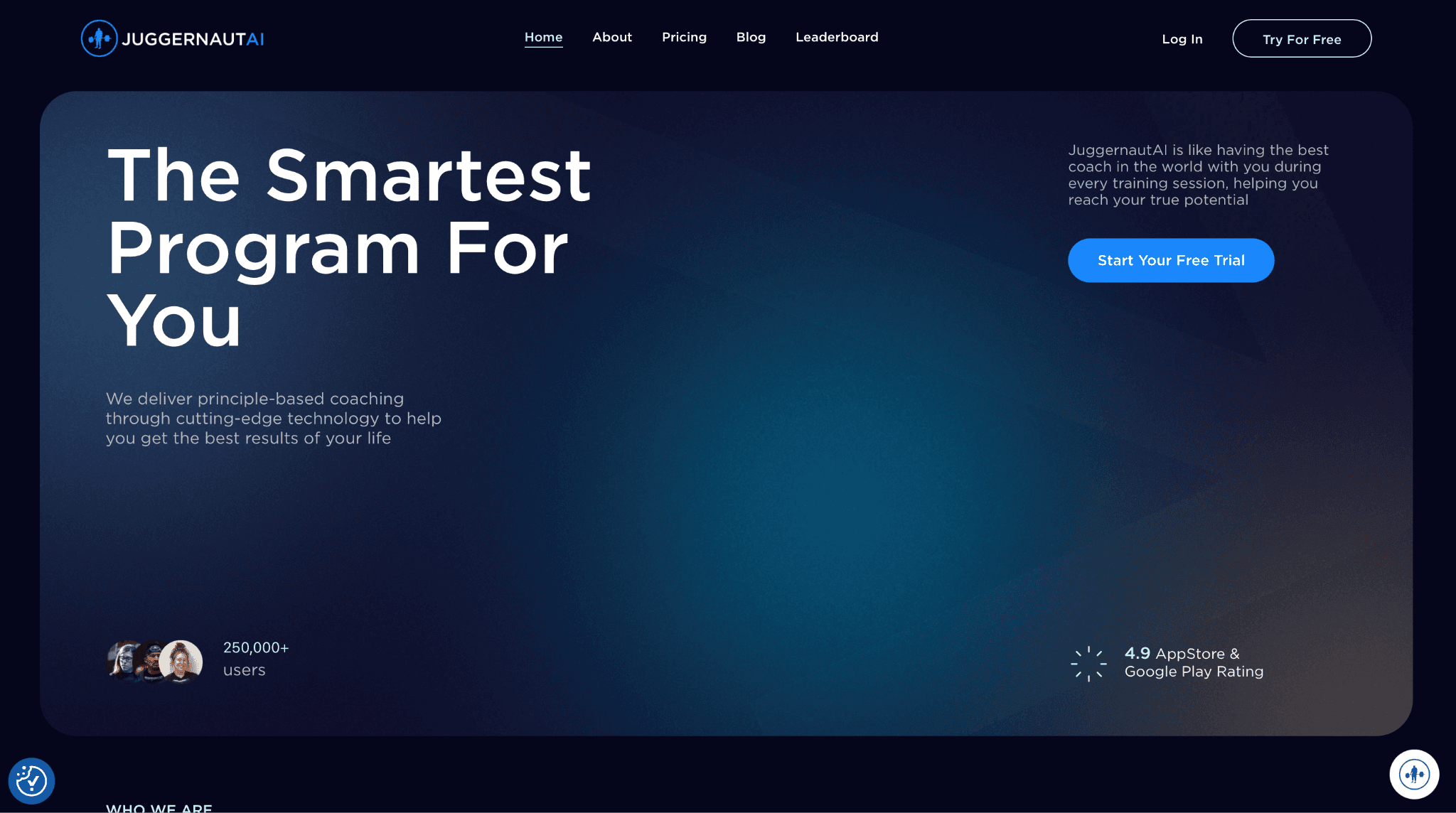
Built by elite powerlifter Chad Wesley Smith on the Juggernaut Method, JuggernautAI comes from a company that's been programming strength athletes since 2009 and now has 250,000+ app users at a 4.9 rating.
You tell it everything: gender, age, size, strength, experience, recovery, and goals. From there its expert system builds a fully individualized, block-periodized plan and adjusts it set to set, day to day, week to week, and block to block based on your RPE and feedback.
Pick Powerlifting or Powerbuilding depending on whether you want maximal strength or strength plus size.
For muscle growth specifically, the Powerbuilding track is the draw: it builds size around heavy compound work, with the periodization and deloads handled for you. You also get 300+ exercise technique videos, a warm-up planner, plate and RPE calculators, a Meet Day Advisor that calculates competition attempts, and weekly video Q&As with Juggernaut coaches. It's the closest an app gets to having a real strength coach in your pocket, which is exactly why it costs what it does.
Pros
The deepest, most credible adaptive periodization in this roundup
Real adjustments based on your feedback at every level, from set to block
A Powerbuilding option that grows muscle alongside strength
300+ technique videos and an active coached community with weekly Q&As
Cons
Easily the most expensive option here, with no free tier
Narrow focus: powerlifting and powerbuilding, not general fitness
Overkill and intimidating for casual lifters or pure aesthetics
Requires honest, consistent feedback to work well
Pricing
$34.99/month or $349.99/year, with a 2-week free trial. Steep next to a tracking app, cheap next to a human coach with Smith's pedigree.
AI & Personalization Features
An expert system that builds a totally individualized, block-periodized plan
Adjusts set to set, day to day, week to week, and block to block on your feedback
RPE-based autoregulation plus a Meet Day Advisor that calculates your attempts
Who should skip it?
Beginners, budget-conscious lifters, and anyone whose main goal is general fitness or fat loss rather than serious barbell strength.
Verdict
If you want a coach in your pocket and care about strength as much as size, nothing here competes. For everyone else, it's more app, and more money, than your goals actually require.
Scorecard
Personalization | 9 |
Tracking | 8 |
AI coaching | 9 |
Ease of use | 6 |
Exercise library | 6 |
Pricing | 3 |
Community | 7 |
Weighted overall | 7.4/10 |
4. Boostcamp - Best Free Coach-Designed Programs
Best for: Lifters who'd rather run a proven, coach-written program than trust an algorithm, without paying a cent.
About Boostcamp
Boostcamp's pitch is simple and a little subversive: why let an algorithm guess when you can run a battle-tested program written by an actual coach?
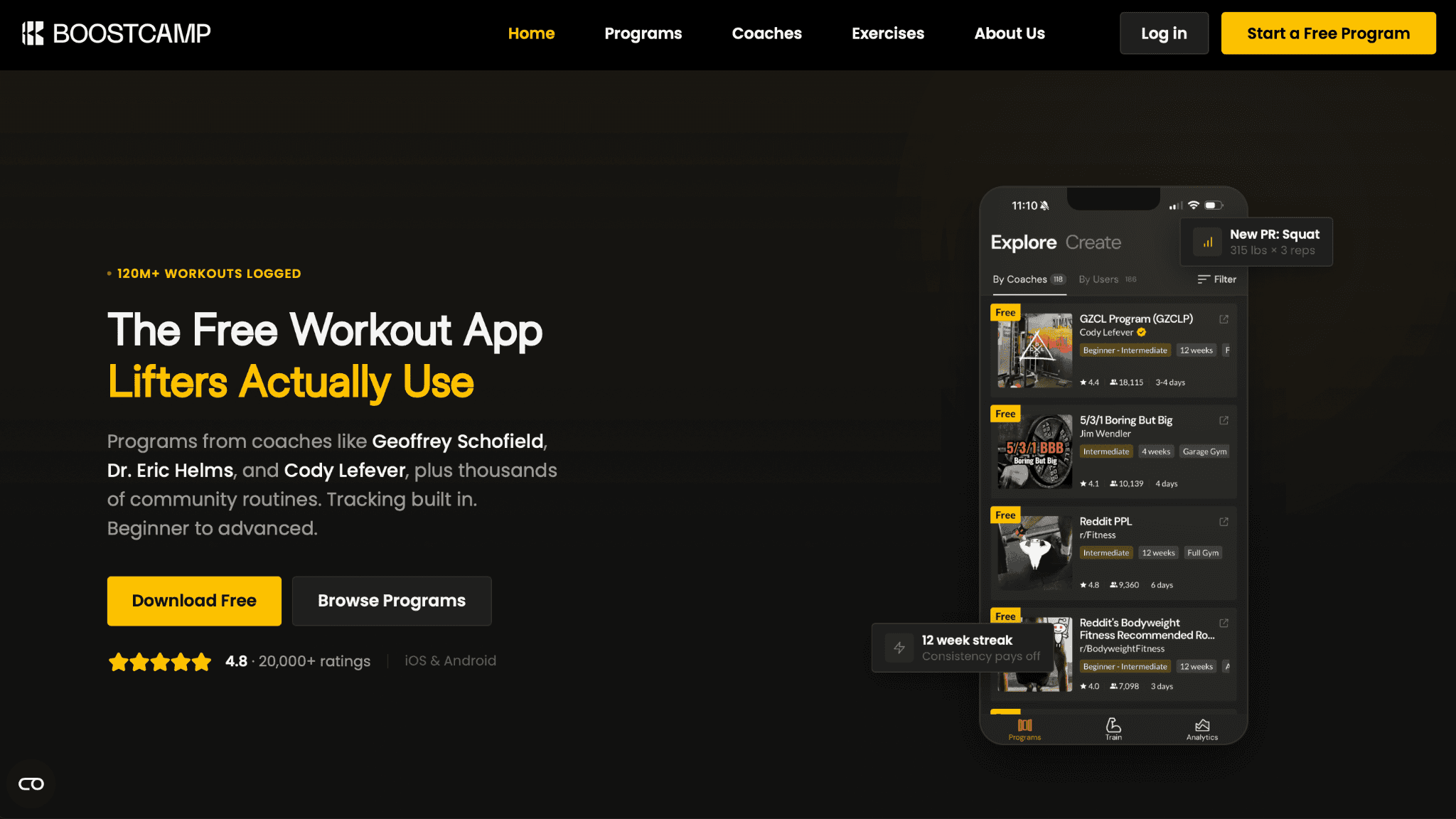
Its free tier includes 11,000+ programs, 130+ of them coach-designed, from names like Jim Wendler (5/3/1), Cody Lefever (GZCLP), Eric Helms, and Geoffrey Schofield, alongside Reddit favorites like nSuns, PHUL, and PHAT.
That free tier is the whole app, not a demo. You get the full workout tracker, automatic progressive overload, RPE/RIR logging, a plate calculator, rest timers, and PR and estimated-1RM analytics, with no ads and no time limit.
It's trusted by 1.2M+ lifters who've logged 120M+ workouts at a 4.8 rating.
For muscle growth, the value is in the curation. Instead of an algorithm reinventing the wheel each session, you run a periodized hypertrophy or powerbuilding program that already has progression and deloads built in by people who coach for a living.
It's primarily a curated library with auto-progression rather than an adaptive coach, though it does include an AI program builder if you'd rather generate one. For a huge number of lifters, picking a proven plan beats generation outright.
Pros
The most generous free tier here: the real app, not a stripped-down trial
An elite library of proven, periodized programs with deloads built in
Solid tracking, plate calculator, and PR analytics at no cost
iOS, Android, and web, with auto-progression included free
Cons
No adaptive coaching; the optional AI builder is a convenience, not a real-time coach
You pick a program rather than have one tailored to you
Pro's "personalized" periodization is a light questionnaire, not deep AI
Less hand-holding than a generator if you're brand new
Pricing
Free covers nearly everything. Boostcamp Pro is $4.99/month billed annually ($59.99/year) and adds a strength score, per-muscle volume heatmap, and exclusive coach programs.
AI & Personalization Features
Automatic progressive overload that handles the load math on any program
An optional AI program builder if you'd rather generate a plan than pick one
The real intelligence is human: 130+ coach-written, periodized programs
Who should skip it?
Lifters who want an app to continuously adapt training in real time. Boostcamp generates and tracks well, but it won't autoregulate like JuggernautAI or Alpha Progression.
Verdict
The best free Fitbod alternative, full stop, and the smartest pick if you trust proven coach programming over algorithmic guessing. For most muscle-building lifters, that trade is a clear win.
Scorecard
Personalization | 6 |
Tracking | 8 |
AI coaching | 3 |
Ease of use | 8 |
Exercise library | 9 |
Pricing | 10 |
Community | 7 |
Weighted overall | 7.0/10 |
5. Freeletics - Best for Training Without a Full Gym
Best for: Lifters who train at home, travel often, or want bodyweight and conditioning work alongside the iron.
About Freeletics
Founded in Munich in 2013, Freeletics is now trusted by 60 million users across 450M+ training sessions, which makes it one of the most established adaptive coaches in digital fitness. It bills itself as "the AI Coach for busy people," and the adaptation is real.
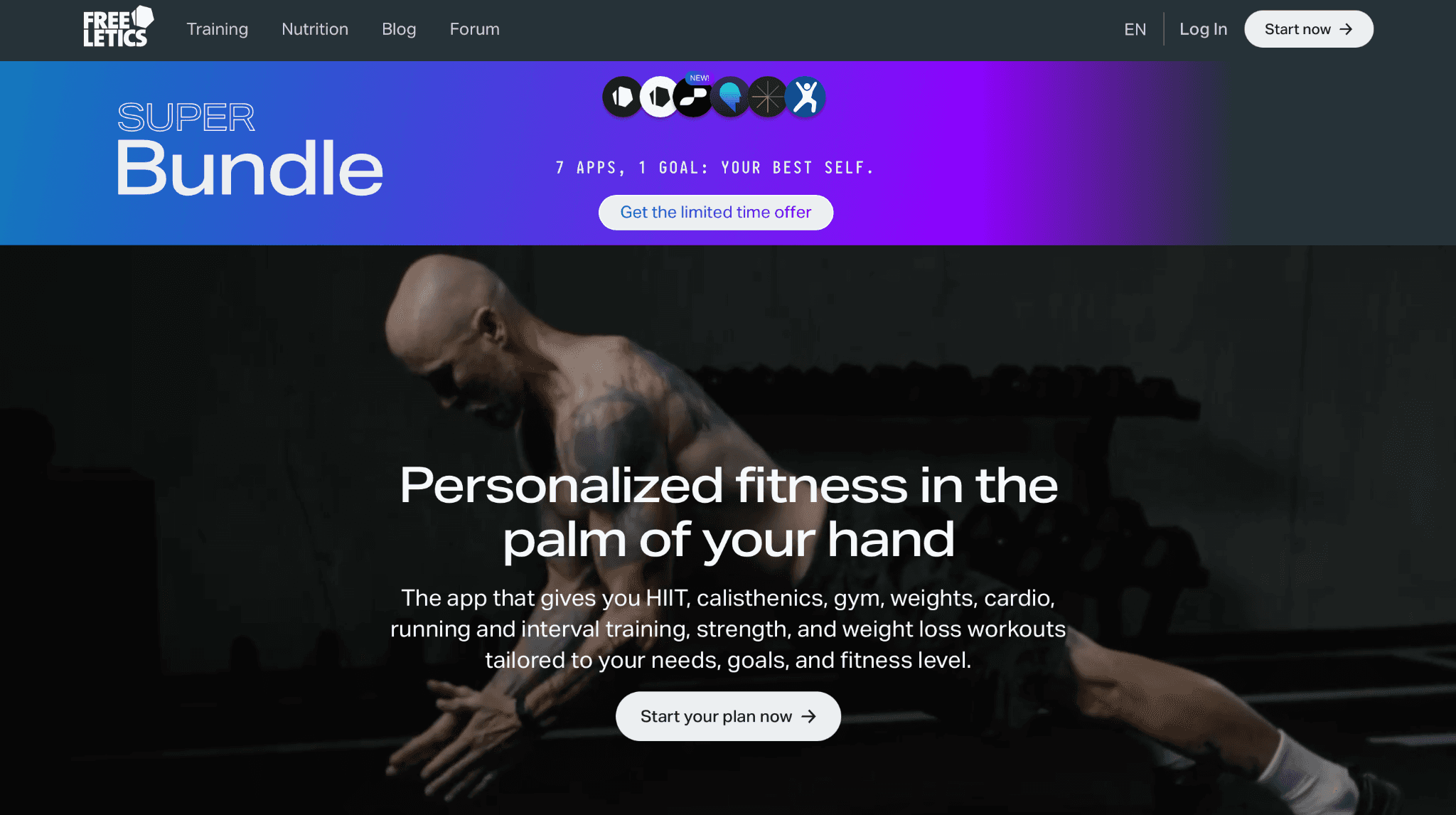
Here's how it works: you rate each session's difficulty, and the AI Coach reshapes your next week around it, easier when you're cooked, harder when you cruise.
You set your training days, time, location, and equipment, and it programs around the life you actually have. It spans HIIT, calisthenics, gym, weights, cardio, running, and strength across 700+ exercises, with 4K, three-angle form videos that are the best teaching tool in this roundup, plus an optional Nutrition Coach.
For muscle growth, it's strongest with bodyweight and minimal equipment. It does have gym and weights modes, but for a barbell-focused hypertrophy block with precise set-by-set logging, a dedicated lifting app like Alpha Progression gives you more control.
Freeletics is solving a different problem, getting you genuinely fit anywhere, and it solves it better than anything else here.
Pros
A coach that genuinely re-plans week to week off your feedback
The best bodyweight and HIIT programming, plus 4K form videos
Optional nutrition coaching, which most rivals here ignore
Works anywhere, with or without equipment
Cons
Weaker than dedicated lifting apps for barbell hypertrophy and precise logging
Adaptation runs on self-report, not wearables or readiness data
Pricing is opaque and promotion-driven
Less precise as a pure strength-training logbook
Pricing
The Training Coach subscription lists around $1.54/week (billed every three months) and Training & Nutrition bundle lists around $1.92/week.
AI & Personalization Features
An AI Coach that reshapes next week's plan from the difficulty you report
Programs around your chosen days, time, location, and available equipment
Adapts on self-reported effort rather than wearable or recovery data
Who should skip it?
Lifters whose main goal is barbell hypertrophy or maximal strength. This is a conditioning-first, train-anywhere coach, not a dedicated lifting app.
Verdict
The best pick if your gym is a hotel room or a corner of the living room. For barbell-driven muscle growth, the dedicated lifting apps above will serve you better, but for training anywhere, nothing beats it.
Scorecard
Personalization | 7 |
Tracking | 6 |
AI coaching | 7 |
Ease of use | 8 |
Exercise library | 7 |
Pricing | 5 |
Community | 6 |
Weighted overall | 6.7/10 |
6. TheBean.ai - Best for Combining Training and Nutrition
Best for: Lifters tired of running a workout app and a separate macro tracker that never talk to each other, and who don't mind using an early product.
About TheBean.ai
Now the part where we review our own app, with both hands visible. TheBean.ai is the newest and least proven option here, so here's exactly what it does today versus where it's headed.
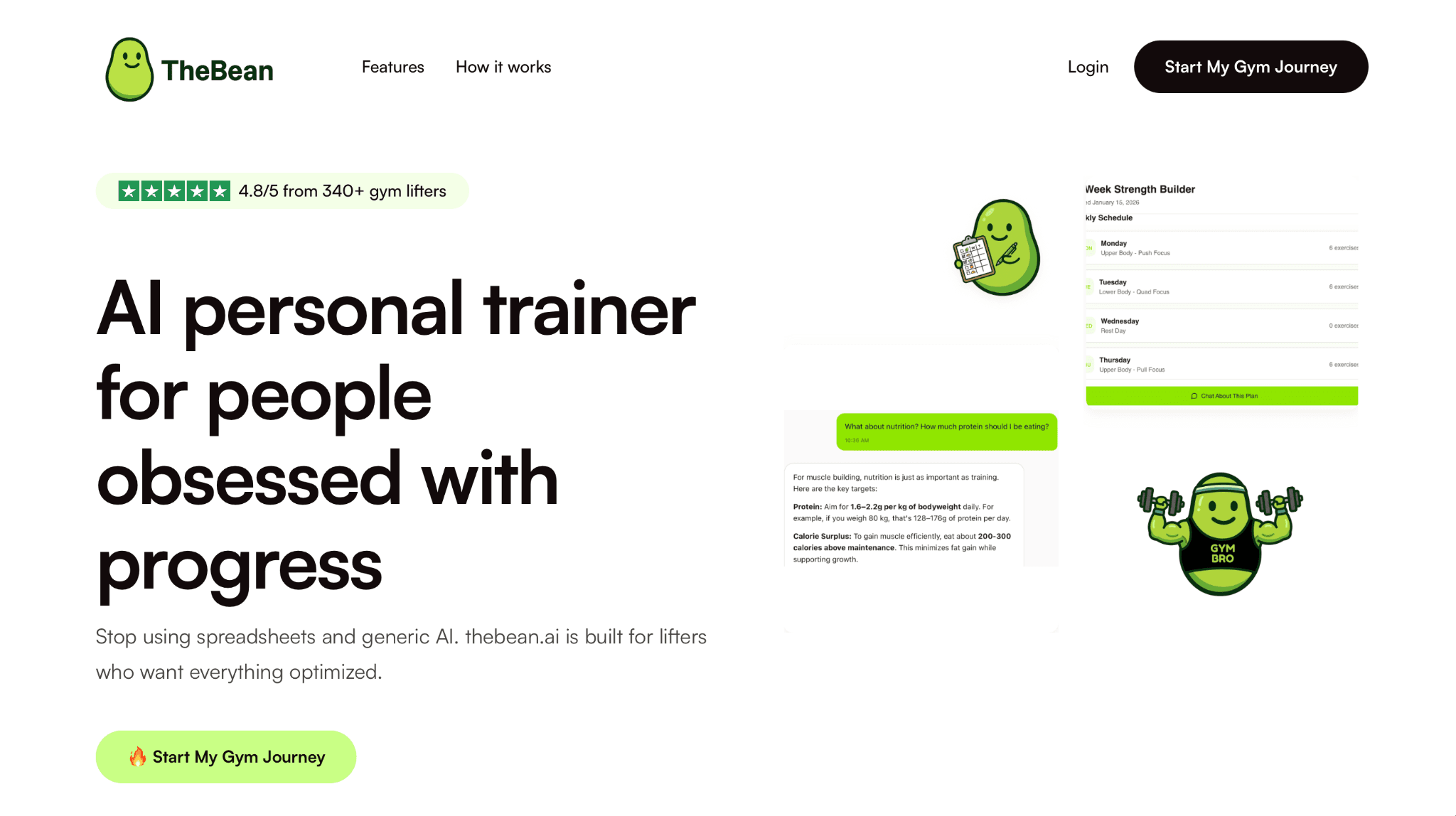
What it does right now: two AI agents, GymBro Bean for workouts and Macro Bean for meals, share one memory of your goals, measurements, injuries, and food preferences, called Your Locker.
GymBro Bean builds your split (PPL, Upper/Lower, Full Body), pushes progressive overload, and lets you swap exercises or change days by chatting in plain language.
Macro Bean calculates your macros, builds protein-first meals around foods you like, and generates weekly shopping lists.
The two stay synced, so training harder automatically raises your calories.
That training-and-nutrition link is the real differentiator, because protein intake of 1.4 to 2.0 g/kg is half the muscle-building equation and almost every app here ignores food entirely.
What it doesn't do yet: deeper recovery-aware coaching, wearable sync, and behavioral coaching are roadmap, not shipped. It's web-first with no native mobile app, and the user base is small (4.8/5 from 340+ early lifters). An emerging Fitbod alternative, not a giant-killer.
Pros
The only app here that builds training and nutrition from shared data
Conversational: adjust workouts or meals by chatting in plain language
Protein-first meals and shopping lists that sync to your training
Free to start, with everything in one place
Cons
Early-stage and small; the track record isn't there yet
Web-first, with no native mobile app at the time of writing
Deeper adaptive coaching and recovery features are roadmap, not shipped
Smaller exercise and program depth than the established apps
Pricing
Free to start via the web app. Pricing tiers aren't published on the marketing site yet, so check the current cost when you sign up.
AI & Personalization Features
Two AI agents (workouts and meals) sharing one memory of your data
Adjust either by chat in plain language, with changes applied instantly
Calories auto-sync to training intensity; deeper adaptation is on the roadmap
Who should skip it?
Anyone who needs a proven, full-featured tool today, a native mobile app, or recovery-aware adaptive coaching right now.
Verdict
Promising, honest about its stage, and aimed at a real gap: training and nutrition in one place. If that combination is what you've been missing and you don't mind an early product, it's worth a look. Otherwise, the proven apps above have more road behind them.
Scorecard:
Personalization | 7 |
Tracking | 5 |
AI coaching | 6 |
Ease of use | 6 |
Exercise library | 5 |
Pricing | 7 |
Community | 3 |
Weighted overall | 5.9/10 |
7. Strong - Best for Simplicity and Beginners
Best for: Lifters who want the fastest, cleanest logbook on the App Store and zero algorithmic noise.
About Strong
Strong has one belief and refuses to budge: think less, lift more. No AI, no nutrition, no social feed. Just the quickest way to log a set and get back to your rest timer.
It launched in 2014 and has spent a decade sanding down the logging experience until there's nothing left to remove, which is why 5M+ lifters at a 4.9 rating (125k App Store and 27k Google Play reviews) stick around, including powerlifters who tried everything else and came back. It runs on iPhone, Android, and Apple Watch, with Strong Cloud syncing across devices.
For muscle growth, simplicity is genuinely a feature in year one. The whole game early on is showing up and adding weight consistently, and Strong makes both frictionless: log a set in a couple of taps, and PRs surface in real time. You also get more depth than its minimalism suggests, including supersets, RPE, advanced charts, body measurements, a muscle heat map, and CSV export.
The ceiling is that Strong won't tell you what to do or progress you. You bring the program; Strong remembers it. For a beginner overwhelmed by Fitbod's constant decisions, that trade is often exactly right.
Pros
The fastest, cleanest logging experience on iOS
Deeper tracking than it looks: PRs, RPE, charts, and a muscle heat map
A one-time lifetime option, so you can pay once and forget it
Brutally honest about what it is, with no algorithmic noise
Cons
No AI, no generation, no adaptation, by design
iOS-first; Android and web experiences lag behind
The free tier caps you at three routines
No nutrition support, and the design is starting to show its age
Pricing
Free forever for basic logging, capped at three routines. Strong Premium runs $4.99/month or $29.99/year, with a lifetime option historically offered near $99.99.
AI & Personalization Features
None, and Strong is honest about it: "you do the work"
No workout generation, progression, or adaptation of any kind
You supply the program; Strong's job is to log and chart it cleanly
Who should skip it?
Anyone who left Fitbod wanting AI. Strong is the opposite philosophy, a logbook, not a decision-maker.
Verdict
A 5/5 logger and, deliberately, a low scorer as an AI alternative. If you want simplicity and you'll bring your own program, it's perfect. If you want intelligence, it was never trying to give you that.
Scorecard
Personalization | 4 |
Tracking | 8 |
AI coaching | 1 |
Ease of use | 9 |
Exercise library | 7 |
Pricing | 6 |
Community | 2 |
Weighted overall | 5.5/10 |
Fitbod vs Other Apps
Feature | Fitbod | Alpha Progression | Hevy | JuggernautAI | Boostcamp | Freeletics | TheBean.ai | Strong |
Workout generation | ✅ | ✅ | ⚠️ Hevy Trainer | ✅ | ⚠️ AI builder + programs | ✅ | ✅ | ❌ |
Adaptive progression | ✅ | ✅ | ⚠️ Auto-progression | ✅ Deepest | ✅ Auto-progression | ✅ Self-report | ⚠️ Basic | ❌ |
Progress tracking | ✅ | ✅ Volume/muscle | ✅ | ✅ | ✅ | ✅ | ✅ Basic | ✅ |
AI coaching | Limited | Moderate | ❌ | ✅ Strongest | ❌ | Moderate | Planned | ❌ |
Nutrition features | ❌ | ❌ | ❌ | ❌ | ❌ | ✅ Add-on | ✅ | ❌ |
Recovery / wearables | ❌ | ❌ | ⚠️ Watch only | ❌ | ❌ | ❌ | Planned | ⚠️ Watch only |
Exercise library | Large + video | 550+ video | Large + video | 300+ video | 11,000+ programs | 700+ video | Smaller | Large |
Customization | Moderate | High | High | High | High | Moderate | Moderate | Moderate |
Free plan | ❌ Trial only | ⚠️ Limited | ✅ Generous | ❌ Trial only | ✅ Full app | ⚠️ Limited | ✅ To start | ✅ 3 routines |
Platforms | iOS, Android | iOS, Android | iOS, Android, Watch, web | iOS, Android | iOS, Android, web | iOS, Android | Web only | iOS, Android, Watch |
Starting Price | $15.99/mo | ~$9.99/mo | Free / $2.99 | $34.99/mo | Free / $4.99 | $1.54/week | Free to start | Free / $4.99 |
Workout Philosophy Comparison
The fastest way to pick is to match the app's core belief to yours.
App | Core philosophy |
Fitbod | Generate a workout on demand |
Alpha Progression | Science-based, transparent progression |
Hevy | Tracking first, community second |
Strong | Simplicity above all |
Boostcamp | Run a proven, coach-written program |
Freeletics | Conditioning anywhere, minimal gear |
JuggernautAI | Strength optimization and peaking |
TheBean.ai | Training and nutrition in one system |
What Makes a Great Fitbod Alternative?
A great Fitbod alternative isn't the one with the slickest onboarding. It's the one that handles the few things muscle growth actually depends on. Here's what to look for, and the research behind each.
Personalization that fits your body, not a template: Identical programs produce strength gains ranging from −8% to +60% between people, so the plan has to reflect your goals, equipment, and history. Alpha Progression and JuggernautAI do this best.
Progressive overload you can see: Continued growth requires progressively greater demand on the muscle, which the ACSM calls foundational. A great app applies it automatically and shows you the logic, instead of moving weights in the dark like Fitbod.
Tracking that teaches: For hypertrophy, the numbers that matter are weekly volume per muscle group and whether your top sets are climbing. Charts should surface that, not just store your history.
Adaptation, not just generation: A generator spits out a session. A coach reads how you responded and adjusts the next block. That gap is the single biggest reason serious lifters outgrow Fitbod.
Nutrition and recovery awareness: You don't grow without enough protein (1.4 to 2.0 g/kg), yet most apps ignore food entirely. Recovery matters too, though it's a useful input, not magic.
An experience you'll actually stick with: Only 18% of beginners last six months, and early consistency predicts the rest. The best ai fitness app is the one still on your phone in week five.
The best alternative is the one you'll still open in week five, whether that's a free logger or a coached program.
Which Fitbod Alternative Should You Choose?
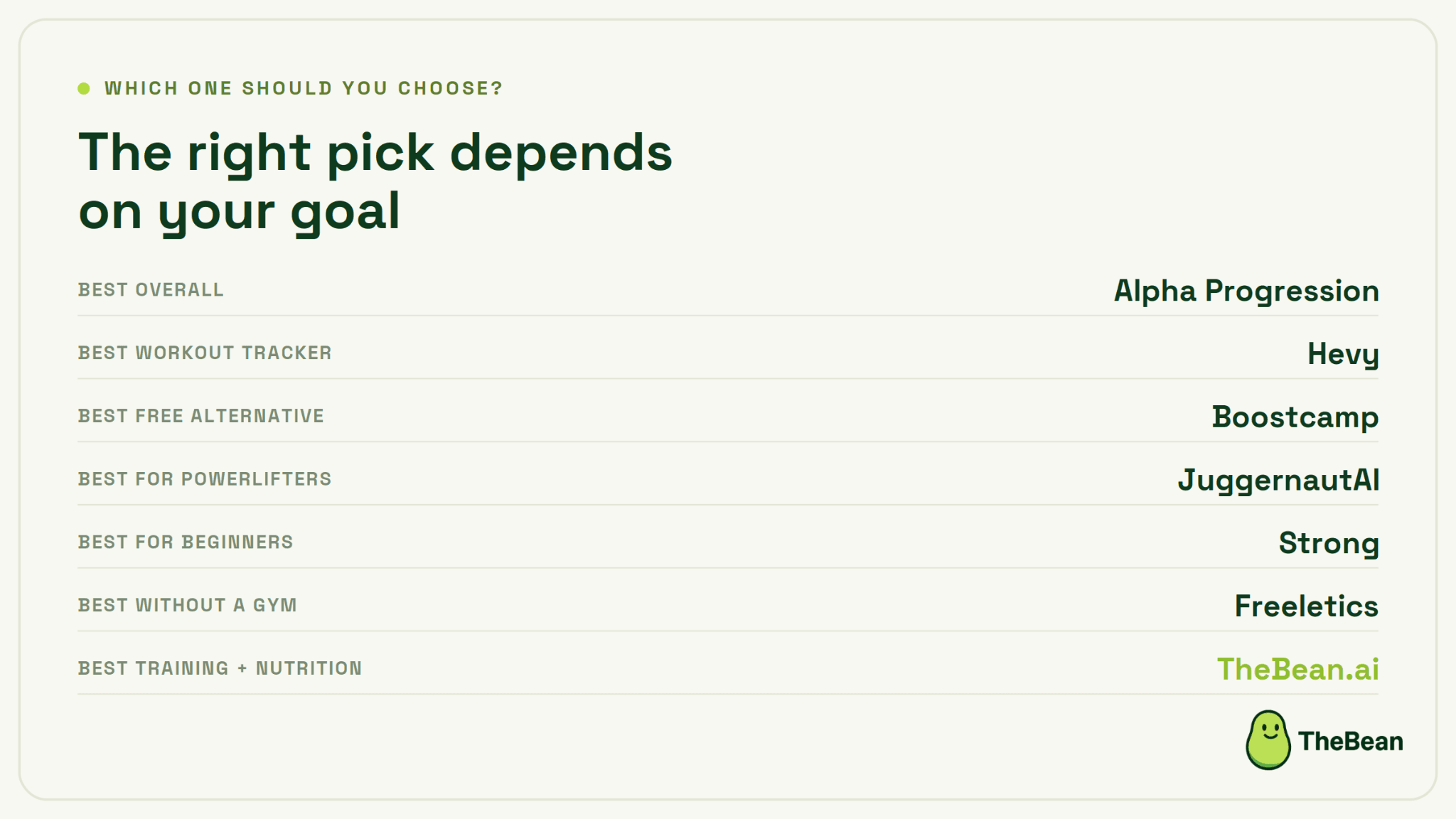
If you want | Choose |
Best overall | Alpha Progression |
Best workout tracker | Hevy |
Best free alternative | Boostcamp |
Best for powerlifters | JuggernautAI |
Best for beginners | Strong |
Best AI coaching vision | TheBean.ai |
Best home training app | Freeletics |
Our Final Rankings
Alpha Progression (7.9): the most complete one-to-one Fitbod upgrade
Hevy (7.7): best tracker and the safest switch for most people
JuggernautAI (7.4): unmatched for serious strength athletes
Boostcamp (7.0): the best free option, period
Freeletics (6.7): the pick if you train without a full gym
TheBean.ai (5.9): promising and honest about its early stage
Strong (5.5): a brilliant logger, a deliberate non-AI app
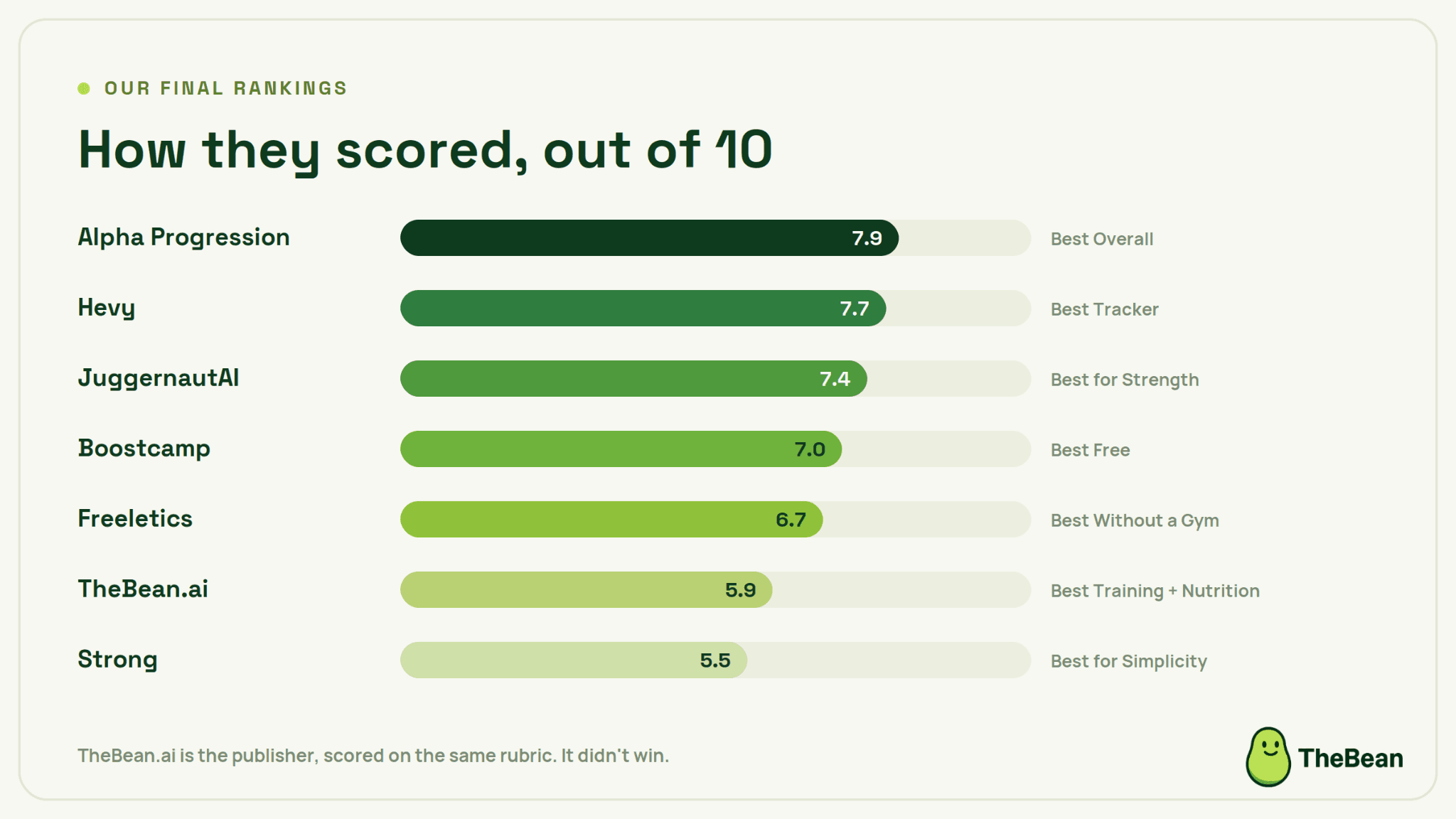
For reference, Fitbod itself scores 7.1, which would slot it between JuggernautAI and Boostcamp. The takeaway isn't that Fitbod is bad. It's that for most specific needs (price, transparency, free access, strength, or nutrition), one of these does that job better.
Frequently Asked Questions (FAQ)
1. What is the best Fitbod alternative?
For most lifters, Alpha Progression is a better option. It delivers Fitbod's "tell me what to lift" convenience with transparent, science-based progression at a fraction of the price. If you mostly want to track your own training, go for Hevy, a better and cheaper pick.
2. Is Hevy better than Fitbod?
If it comes to tracking and value, yes. Hevy has a far better free tier and lower price. For automatic workout generation, Fitbod still does more, though Hevy's 2026 Hevy Trainer narrowed the gap.
3. Is Strong better than Fitbod?
Only if you want simplicity. Strong is the cleaner logger but has no AI or generation. If you left Fitbod wanting intelligence, Strong is the wrong direction.
4. Is Alpha Progression worth it?
Well, for muscle-focused lifters, yes, definitely it’s worth it since it’s one of the cheapest AI generators and the most transparent about progression. The main downside is a learning curve that assumes some training knowledge.
5. Why are people leaving Fitbod?
Mostly price, repetitive workout recommendations, limited deep customization, and a preference for transparent coaching over black-box generation.
6. Does Fitbod use AI?
Yes. Fitbod's algorithm generates each session and estimates muscle recovery from your training history to adjust weight and volume. The common criticism is that it's a generator more than an adaptive coach, and it doesn't explain its choices.
7. What app is most similar to Fitbod?
Alpha Progression, which also generates AI plans and manages progressive overload, but more transparently and more cheaply. Dr. Muscle is another close algorithmic match.
8. Are AI workout apps effective?
When they apply real training principles, yes. Progressive overload drives strength and size, and apps that automate it work. Effectiveness depends far more on consistency than cleverness.
9. Can workout apps replace personal trainers?
For programming, progression, and tracking, increasingly yes. For hands-on form correction and real human accountability, not fully. JuggernautAI comes closest to a coach-like experience for strength.
10. What is the cheapest Fitbod alternative?
Boostcamp and Strong (free tiers), then Hevy Pro at $2.99/month are the cheapest Fitbod alternatives. Alpha Progression Pro is the cheapest AI generator at roughly $5–10/month depending on the plan.
11. What is the best free Fitbod alternative?
Boostcamp. Its free tier is the real app: 11,000+ programs, full tracking, and analytics, with no time limit. Hevy is a close second for pure logging.
12. Which app is best for muscle growth?
Alpha Progression for most lifters, thanks to its volume-per-muscle progression. JuggernautAI for those who want a powerbuilding focus with deep periodization.
13. Which app is best for beginners?
Strong for dead-simple logging, or Boostcamp if you want a guided, proven program without paying. Both are gentler entry points than Fitbod.
14. Which app offers adaptive workouts?
JuggernautAI (the most adaptive, via readiness and RPE) and Freeletics (adaptive off self-reported difficulty). Alpha Progression adapts progression based on logged performance.
15. Which app combines nutrition and training? TheBean.ai is the only one here that generates both training and nutrition from shared data. Freeletics offers nutrition as a separate add-on.


