Alpha Progression: How to Use It for Progressive Overload

Written By:
Pragati G.
Content Manager @ TheBean.ai

Reviewed By:
Algirdas S.
Founder @ TheBean.ai
Expert Verified


A workout log tells you what you lifted. It does not necessarily tell you whether to add another repetition, use the next pair of dumbbells, or adjust your target after a difficult first set. Those decisions are where tracking becomes useful for planning the next workout.
Alpha Progression is a strength training app for iOS and Android that combines workout logging with personalized training plans and performance-based weight and rep recommendations. The free version supports self-directed training; Pro adds planning, progression guidance, and more detailed analysis. Understanding how these pieces work together matters more than simply collecting more workout data.
Start with a plan you can actually follow
Before choosing exercises, establish your practical constraints: how often you can train, how much time you have, and which equipment you can use. A four-day routine is not automatically a better choice than a three-day routine if the fourth session rarely happens.
Alpha Progression's plan generator uses your experience, goals, schedule, equipment, and muscle priorities to create a complete program. It sets the split, exercises, set counts, and repetition targets. You can edit the result or build your own routine instead.
Muscle priorities are useful when you want to emphasize particular areas, such as your upper chest or lateral delts. They express a relative preference: prioritizing everything is not the same as giving one area extra attention. Choose the priorities that matter to you rather than treating every muscle as a special case.
Review the generated plan before starting. Check that the equipment exists in your gym and that the session fits your available time. Replace an unsuitable exercise without rebuilding the entire program.

Figure 1. The plan editor keeps exercise selection, sets and rep targets editable. Detail from an Alpha Progression screenshot.
Separate your training record from your next target
During a workout, there are two different numbers to understand: the performance in your log and the recommendation for what to attempt. Keeping them separate prevents a common mistake: recording the planned result rather than the result you achieved.
Alpha Progression's weight and rep recommendations consider previous workout performance and sets already completed in the current session. They begin from the second workout involving a particular exercise, once a previous performance is available. They also work with manually created routines, not only generated plans.
In the squat screenshot below, the set fields show 215 lb for eight repetitions, while the blue recommendation bubble shows 220 lb for eight. The bubble underneath set 1 belongs to set 1; it is not an additional set. Read the bubble as guidance, then enter the weight and repetitions you actually complete.
This is an interface example, not a rule that everyone should add five pounds after eight repetitions. Your own targets depend on your recorded performance and settings.
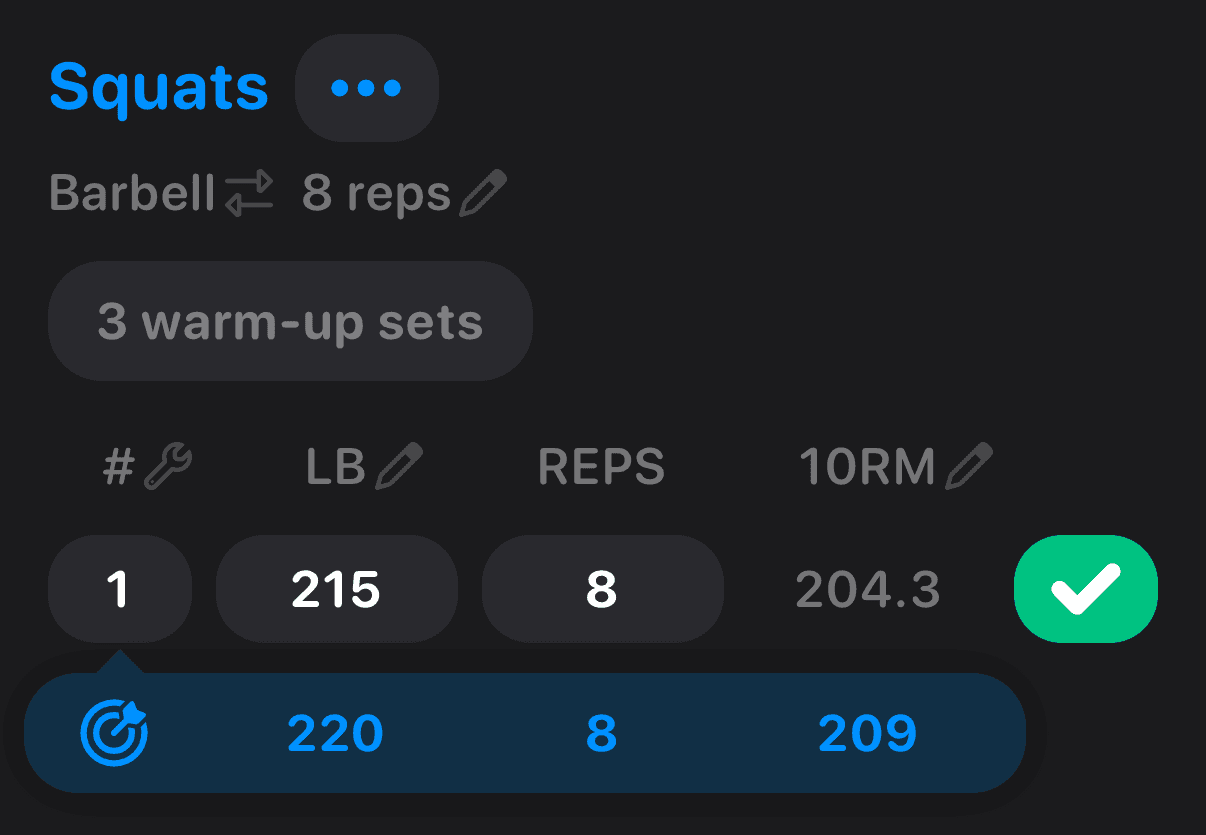
Figure 2. The squat logger separates the set fields from the blue weight-and-rep recommendation. Detail from an Alpha Progression screenshot.
Progress does not always mean a heavier weight
Progressive overload involves increasing training demands over time. More repetitions can be one way to progress; moving up in weight is another. Treating the next heavier dumbbell as the only valid improvement can make progression unnecessarily rigid.
For illustration, moving from a 20 lb dumbbell to a 25 lb dumbbell is a 25% increase. That is a large jump compared with adding one repetition. Alpha Progression accounts for the weights available in your gym when calculating a weight-and-rep combination, rather than assuming every possible load is available.
The recommendation may therefore favor more repetitions before a heavier load. It may also move downward after a set that goes worse than expected. Neither response means the plan has failed. A useful target reflects today's performance as well as your longer-term direction.
Accurate logging is essential. Enter the result you achieved, even when it differs from the suggestion. Check your equipment's weight settings if a target looks impractical. An incorrect maximum weight or increment limits the options the app can recommend.
Compare like with like, then look at the trend
Different rep ranges make workout records harder to compare. Is a heavier set with fewer repetitions an improvement, or simply a different task? Alpha Progression uses an estimated 10RM, the estimated weight someone could lift for ten repetitions to failure, to provide a common performance metric.
Beginners can use this without performing a maximum-effort test. However, it remains an estimate, not a measurement of muscle growth or a guarantee of what you could lift. Compare the same exercise under reasonably consistent conditions, and keep changes in technique, range of motion, or equipment in mind.
Pro's charts make those patterns easier to inspect. Look across repeated sessions rather than treating one low point as a reason to replace the whole program. Training frequency, exercise performance, and body measurements answer different questions; no single chart explains everything.

Figure 3. Workout frequency and estimated bench-press 10RM displayed as separate trends. Detail from an Alpha Progression screenshot.
Keep advanced settings optional
RIR means repetitions in reserve: your estimate of how many more clean repetitions you could have completed after a set. Beginners can leave RIR disabled and still receive progression recommendations. Learning to log accurately is a useful starting point without adding another number to estimate.
More experienced lifters can enable RIR when they want to record effort alongside weights and reps. Pro also supports periodization and planned deloads. These let a program vary sets, repetitions, and optional RIR targets across its weeks and include an easier phase. They are available tools, not prerequisites for making the app useful.
Consistency does not require inflexibility. Use the plan generator for your regular routine and the standalone workout generator for a one-off session, such as training in a hotel gym. A temporary change of equipment need not become a completely new long-term program.
Decide whether you need a tracker or training guidance
Alpha Progression's current feature and pricing information distinguishes a permanent free workout log from Pro's additional guidance. Free includes unlimited, ad-free logging, manually created plans, and all 795 exercises with demonstration videos and instructions. It can suit someone who already knows how they want to train.
Pro adds personalized plan and workout generation, progression recommendations, charts, and advanced tools. Standard US pricing is $12.99 per month or $79.99 per year; local prices may differ. The practical reason to upgrade is wanting help with programming and next-set decisions, not simply needing somewhere to record a workout.
The app is aimed at beginners through advanced lifters focused on muscle and strength. Its main purpose is resistance training rather than nutrition tracking or cardio classes.
A useful first-week approach
Start by entering your actual equipment and choosing a realistic training schedule. Generate a plan or add your existing routine, then log your first sessions carefully. Recommendations become available from the second workout involving each exercise, so do not expect a personalized target for a movement with no recorded history.
After that, keep the process straightforward: read the recommendation, perform the set, record the actual result, and review your progress over time. Adjust the plan when your circumstances change, not merely to make every workout different.
That is the practical role of Alpha Progression: connecting what you planned, what you actually did, and what you can aim for next. The value comes from using those connections consistently, not from assuming an app can guarantee results.


